Food Access Solutions Taking Shape in Rural Pennsylvania
Smoothing out the uneven geography of hunger

As his shift winds down, store manager John Belfiore pushes a wide broom across the tile floor of Cambridge Grocery. He can still name the grocers that once anchored the rural town of Cambridge Springs, including Vogel's Food Mart and Peterson's Golden Dawn.
Cambridge Grocery opened in September 2025 in the building that once housed Hendrickson's True Value Hardware. Its dark wood façade and outdoor display area still whisper hardware, while inside, bright white aisles cut through the open floor, stocked with canned goods, milk and eggs, and bins of fresh produce.
In Cambridge Springs, residents still remember Vogel's Food Mart – its child-sized grocery carts and hot coffee that made the store feel like part of the neighborhood. The store closed not long after a Dollar General opened down the street, a shift that reshaped how the town buys its groceries.
This shift in local food options is a trend beyond Cambridge Springs. There are 977 Dollar Generals across Pennsylvania, with 30 in Erie County alone. A study by the U.S. Department of Agriculture found the likelihood that a rural grocery store will close after a dollar store opens nearby is three times higher than in urban communities.
For many rural communities in Northwestern Pennsylvania, access to fresh, affordable food is a daily challenge. Residents often travel miles to reach a retail grocery store, and the arrival of big-box and dollar stores has reshaped local food landscapes – sometimes closing the doors on long-standing neighborhood staples. While rural areas may have smaller populations, a larger share of residents face food insecurity. According to Feeding America, the 20 counties in Pennsylvania with the highest rates of food insecurity are predominantly rural.
Cambridge Grocery is the only locally owned food store in Cambridge Springs, a town of about 2,200 people. The nearest full-scale supermarket is Walmart Supercenter, located roughly 10 miles away. A Giant Eagle in Edinboro, which previously offered free grocery delivery to Cambridge Springs, closed in 2022.
Residents with reliable transportation can access both big-box stores and locally owned options that offer nutritious, locally sourced products. According to Gregory Hall, Chief Executive Officer at the Second Harvest Food Bank of NWPA, distance remains the biggest barrier to food access in rural communities.
"Food deserts exist in both urban and rural communities, but they look different in rural areas. Food insecurity is often less visible there," Hall said. "One of the biggest problems is that families live miles from the nearest grocery store or food pantry. Transportation is a significant barrier – distance is the main issue."
Second Harvest serves 11 counties in northwest Pennsylvania, including Cameron, Clarion, Clearfield, Crawford, Elk, Erie, Forest, Jefferson, McKean, Venango, and Warren. These Rust Belt communities, Hall says, "have been hit hard," noting that 10 of the 11 counties are above the national poverty rate.
Hall says hunger affects far more than physical health. Food insecurity can also take a toll on mental health, increasing stress for families already facing financial challenges. Children are especially vulnerable. In Crawford County, for example, about 15 percent of the adult population experience food insecurity, compared to 20 percent of children.
"When a child goes to school not knowing where their next meal will come from, it's hard for them to focus," Hall said. "Hunger affects their ability to learn, grow, and succeed."
Hall says Second Harvest has seen rising food costs place additional strain on families and their ability to put food on the table. In rural areas, those increases can be especially challenging, as residents must also factor in the cost of fuel and transportation to reach grocery stores or food pantries.
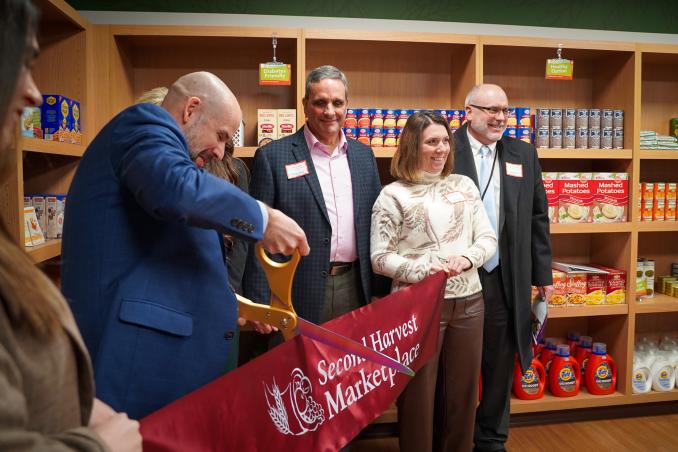
The Second Harvest Marketplace located within the UPMC Health Plan Neighborhood Center on Parade Street had its grand opening in January – the market allows customers to schedule appointments to shop in a clean, modern space. (Contributed photo)
To help bridge these gaps, Second Harvest offers several programs that bring food directly to residents. Their mobile markets and Produce Express program deliver truckloads of food to areas where traditional pantries are unavailable. Each Produce Express truck carries 25 to 50 pounds of nutritious food, enough to serve up to 200 families, completely free of charge. These initiatives provide vital access for residents who might not otherwise be able to reach a grocery store or pantry.
When Cambridge Grocery first opened, some residents raised concerns about prices compared to retailers like Dollar General or Walmart. But in the months since the store opened in September, customers say prices have fluctuated and become more affordable. The store manager noted that produce moves quickly, and the owners welcome customer suggestions for products they'd like to see on the shelves.
Residents have shared their thoughts on social media, praising the store's expanding selection and accessibility. One wrote, "The selection continues to expand and the prices are comparable to other grocery stores. It's so nice to have a local grocery option besides Dollar General." Another added, "Stopped by the new grocery store today. I was pleasantly surprised. Yes, some items were a little more expensive than Giant Eagle or Tops, but I didn't have to drive to Erie or Meadville."
Experts say addressing food access requires more than a single solution – it takes a patchwork of strategies, from supporting independent farmers and grocers, to improving public transportation, to connecting residents to community resources and sustaining federal nutrition programs.
Another approach gaining traction in Northwestern Pennsylvania is Pay-What-You-Can Markets. Stephanie Thauer, who runs a small farm outside Cambridge Springs, helped launch a Pay-What-You-Can Market program in Erie County six years ago with a friend. These markets provide locally grown, affordable produce while directly supporting local farmers and agriculture. The first pilot market opened at 15th and Parade, an area long considered a food desert in Erie's east side.
Since then, the project has expanded to seven markets, with plans to expand into surrounding counties. Open weekly from July through October, the markets offer fresh, locally grown produce that Thauer says customers can trust. The food is grown within the community and without the chemicals or heavy processing often found in convenience store items. Thauer provides a variety of produce from her own farm, including fresh greens and seasonal vegetables.
Thauer runs a small market in Edinboro on Meadville Street, in partnership with Unity in Edinboro, a local church. She opened it in response to the closure of the Giant Eagle, the borough's only large grocery store.
"Every town should have a resource like this," Thauer said.
The markets accept SNAP, EBT, and Farmers Market Nutrition Vouchers – an option Thauer says residents "really appreciate." During the 15-week market season in 2025, the market at 15th and Parade distributed roughly 8,651 pounds of food. The Edinboro market alone distributed about 2,100 pounds, serving 464 people, while the 15th and Parade location reached 1,171 residents.
Thauer says the model improves access to fresh, locally grown produce by allowing customers to pay what they can – through donations, bartering, or traditional payment. The markets are intentionally located in areas that are walkable and accessible by public transportation.
Thauer says the Pay-What-You-Can model not only provides food access, but also offers a dignified shopping experience and strengthens community ties.
"Back in the day, food markets were gathering places. People came not just to shop, but to talk, socialize, and share recipes and experiences," Thauer said. "That's what our markets have grown into. It's about the experience – it's not just people standing in line and being handed food."
On the east side of Erie, another community-driven solution is the Second Harvest Marketplace located in the UPMC Health Plan Neighborhood Center on Parade Street. At no cost and on an appointment basis, residents can shop in a modern, clean grocery space. Staff also provides guidance on new recipes, nutrition tips, and ways to make the most of the food products.
New to the East Side, the Marketplace opened in January 2026, and Hall says feedback from the community has been overwhelmingly positive – especially around the dignity of being able to shop and choose your own food. Second Harvest hopes to expand this model to other communities in need.
In rural towns, these types of solutions often arrive slowly. For many families, the nearest source of fresh produce is far away, leaving them vulnerable to the uneven geography of hunger. Community-driven initiatives – like Cambridge Grocery, Pay-What-You-Can Markets, and local food pantries – provide both dignity and access, showing how localized efforts can make a meaningful difference.
"History has shown us that we're more resilient and able to take care of ourselves and each other when we work together," Thauer said. "When we work within our community, we're not just thinking of ourselves – we're thinking of our neighbors."
In rural communities like Cambridge Springs, independent grocers and community-based solutions are vital lifelines. Although progress is linear, these local efforts highlight the ongoing work needed to ensure that healthy, affordable food is available to residents, no matter where they live.
Julia Carden can be reached at juliacarden91@gmail.com