Squad of Misfits: The Story of Connie Hawkins and the Pittsburgh Pipers
Northwestern Pennsylvania's brush with professional basketball

Growing up in a family loyal to Pittsburgh sports teams, I always had my favorite professional baseball, football, and hockey teams. The trinity of Steelers, Pirates, and Penguins even all share the black and gold, which due to its uniqueness seemed extra cool. As much as I enjoyed those sports though, basketball was always the sport that I gravitated towards, the trading card tables at the flea market where I made my beeline.
Maybe it was the era – you couldn't be a kid in the '90s and not be enthralled by Michael Jordan and the Chicago Bulls (and, let's be real, Space Jam) – but when fellow basketball enthusiasts inquired about my favorite team, I never really knew what to say. As much as I loved Jordan (or the Shaq and Penny Hardaway era Orlando Magic), no team really felt like my team.
Had I been a kid growing up in 1967, I would have been thrilled when it was announced that Pittsburgh was getting a professional basketball team. It actually wasn't the city's first. In the 1930s, the Pittsburgh Pirates basketball team played in the National Basketball League (NBL). In the 1940s, it was the Pittsburgh Ironmen with the Basketball Association of America (BAA). Then in the early 1960s, the Pittsburgh Rens played a single season as part of the short-lived American Basketball League (ABL).
In 1967, there was significant hype over the American Basketball Association (ABA), which would compete directly with the monopolistic National Basketball Association (NBA), itself formed from a 1949 merger between the BAA and the NBL. Many basketball purists didn't love the idea, as the ABA would differentiate itself with the three-point shot (which the NBA then lacked), a longer shot clock, and a faster-paced style of play.
In the Western Division for the first season were the Anaheim Amigos, Dallas Chaparrals, Denver Rockets, Houston Mavericks, New Orleans Buccaneers, and Oakland Oaks, while the Eastern Division included the Indiana Pacers, Kentucky Colonels, Minnesota Muskies, New Jersey Americans, and Pittsburgh's new team: the Pipers.
On Aug. 17, 1967, Vincent Cazzetta, a mild-mannered but experienced college coach, was announced as head coach. Charles "Brute" Kramer, previously of Erie working in the Middle-Atlantic League baseball, was hired as their publicity director. The Civic Arena would host the games.
Now, it was time to build a 12-man roster. In Erie, there were murmurs about Gannon College's "chief sparkplug," the 6-foot-3-inch guard Calvin Graham. He had a breakout senior year, scoring 425 points, hitting the boards for rebounds, and being the team's playmaker. The Pipers eyed him as a swingman. "We like him a lot," a Pipers official confirmed, complimenting his aggressiveness on the court.
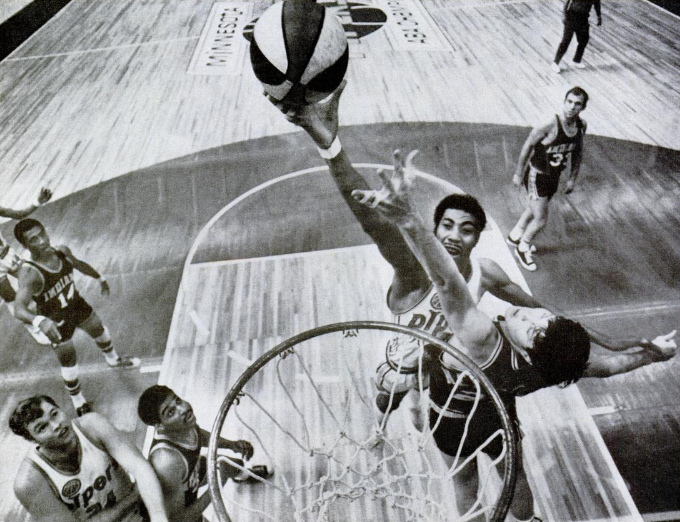 (LIFE Magazine May 16, 1969)
After weeks of cuts, Graham made the team. In their first three exhibition games against the Indiana Pacers in early October, the Pipers won two. Graham played well as did a few others, but after a 120-109 exhibition win against the New Jersey Americans, the team's breakout player was clear: Connie Hawkins. The 6-foot-8-inch power forward drained 31 points, but he also demonstrated that he could do, well… just about everything on the court. This was unusual for a player of his size.
Hawkins had already been on quite a journey – or as Ebony Magazine described it, a "Kafkaesque nightmare." Some believed the 25-year-old baller was as good as the best players in the NBA, where they felt he should already have been playing. Willis Reed, New York Knicks future Hall of Famer, argued that Hawkins would be one of the superstars in his league. "All the guys know it," he said.
Hawkins never had the chance though. His basketball career was derailed while a freshman at the University of Iowa. Still a naive and inexperienced 18-year-old from Brooklyn, his name was caught up in a point-shaving scandal with dozens of players who'd associated with a fixer named Jack Molinas. Despite no wrongdoing on his part (the full story is told in-depth in the exceptional 1972 biography Foul! The Connie Hawkins Story by David Wolf), Hawkins was kicked out of school, banned from the NBA, and even shunned on his home courts in New York.
Hawkins was traumatized. He cried every day. Who even was he without basketball? Had it not been for loyal support from basketball superstars like Reed, Wilt Chamberlain, and Sam Jones, which helped restore his reputation, that might have been the last the basketball world heard from Connie Hawkins.
Some cosmic timing didn't hurt either. That same year, Harlem Globetrotters owner Abe Saperstein founded the ABL and Hawkins signed a $6,500 contract with the Pittsburgh Rens. It was money he couldn't even fathom. After the league folded, Hawkins then joined Saperstein's Harlem Globetrotters.
He played this "barnstorm" style of basketball over the next four years, significantly broadening his playing style and nurturing a deep discipline with ball control. He also reinvented what it meant to dunk, which he said when "stripped to the core" was "the great form of asphalt revenge." During these years he also married, started a family in Pittsburgh, and, with the pro bono assistance of lawyers Roslyn and David Litman (family of the former Rens owner), filed a lawsuit against the NBA. When the Litmans were asked why they were spending tens of thousands of dollars of their own money on the case, their answer was simple: they believed Connie was innocent.
By 1966, Hawkins hung up his Globetrotter shoes and returned to Pittsburgh. He was tired and depressed and ashamed and, during pickup games of playground ball, thought often about missing his prime years in the NBA. "It was the worst time of my life," he'd later say.
A year later though, Hawkins was again lacing up his shoes, this time with the Pittsburgh Pipers. For those who didn't know of him, they would soon. "The first time I saw Connie Hawkins," NBA legend Rick Barry said, "I couldn't believe what he could do with the basketball."
For those who saw him play in Pittsburgh, it was immediately clear that he was different from other big men on the court. Yes, as expected for his size, he could dunk and rebound and block shots, but he also could handle the ball, make playmaking passes, and even had a decent outside shot. Many compared him to Wilt Chamberlain and Oscar Robertson. As sportswriter Dan Barreiro later wrote, he "broadened the possibility" of what could be done on the court." "Hawkins used finesse," Barreiro explained, adding that with "big hands, quick feet, and a huge imagination," he had a "remarkable blend of broken-court moves to the basketball" along with bringing "creativity to the dunk."
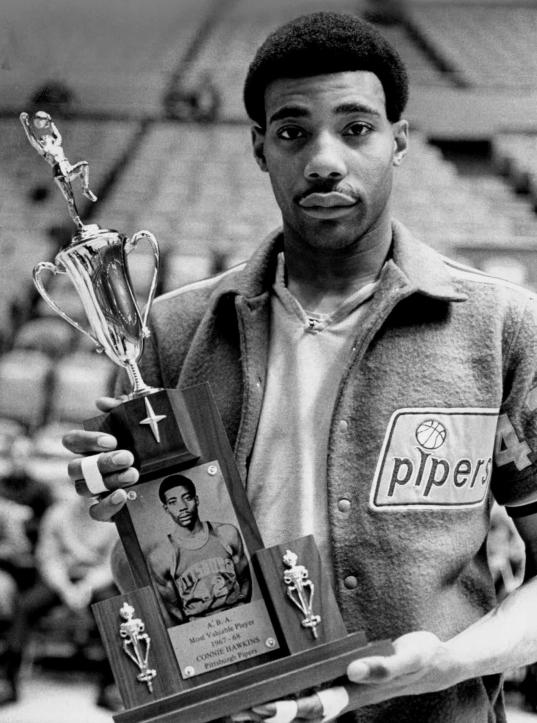 Connie Hawkins, the 6-foot-8-inch power forward for the Pittsburgh Pipers, was described by Ebony Magazine as "Mr. Everything," describing his style as "razzle-dazzle" and "sneaky fast" with "will-o'-the-wispiness and flair." (Wikimedia Commons)
Ebony Magazine called him "Mr. Everything," describing his style as "razzle-dazzle" and "sneaky fast" with "will-o'-the-wispiness and flair." He also had exceptional instincts. As another journalist explained, Hawkins could "take complete command of a ball game" because he could see and analyze the entire court and every player on it all at once. "[Connie is] playing a very fast game of chess," he added. "He knows what's happening everywhere."
"I remember actually being able to freeze frames in my mind and look ahead and see myself doing the move, making the move," Hawkins once explained. In addition to his skills on the court, he was also a natural leader: warm, humble, composed, and unselfish.
Besides Hawkins, the core of this "squad of misfits" was developing. At point guard was Charlie Williams (another blacklisted from the NBA), with Chico Vaughn at shooting guard, Tom "Trooper" Washington as power forward, and Ira Harge, Craig Dill, Jim Jarvis, Rich Parks, Barry Leibowitz, and Calvin Graham in rotation. The regular season opener was against the New Jersey Americans on their court, followed by a home game against the Minnesota Huskies. Pittsburgh defeated New Jersey in a 110-107 nail-biter, but they lost to Minnesota 104-86 in their home opener in front of a crowd of 5,000.
For their third game, they faced the Denver Rockets at home. They stonewalled Hawkins in the first half allowing him a mere two points – before he dominated after halftime with 27 points in the team's 91-77 victory. "As goes Connie Hawkins, so go too the Pittsburgh Pipers," stated an article in the Erie Daily Times.
The following weeks were rocky. With their record at 11-12, home attendance decreased by over 50 percent. The Pittsburgh Post-Gazette called the Pipers the "Losers' Club," while Pittsburgh Weekly Sports took a swipe at Connie for "conning the fans … believing he's the greatest and that the world owes him a living."
The team had a "roster reshuffling," which included letting go of Graham, and signing shooting guard Art Heyman, a scrappy former NBA player and Duke University tough guy. Fellow players described him as "crazy" with a "very explosive" temper. "The trick was to direct the fire the right way," his former college coach explained.
Pittsburgh won their next 15 games. "It took the Pittsburgh Pipers a while to get going but now their [ABA] rivals wonder if and when they'll stop," an article read following a win where they went "wild" with 146 points as they chased Minnesota's first-place ranking.
While they still weren't attracting crowds over 3,000 ("It's almost a feeling like who cares," Coach Cazzetta vented to the Pittsburgh Press), the Pipers ended the regular season with a league-best 54-24 record – a remarkable comeback from their weak start.
Hawkins, the "slender center who does everything well," was named league MVP, with his 26.8 points, 13.5 rebounds, and 4.6 assists per game. Coach Cazzetta called him the "most complete player" in the league. "Defensively and offensively, outside and inside, he is perfect," he said, then added, "I think he is the finest pro basketball player in the country."
Pittsburgh first faced Indiana in the playoffs. Hawkins drained 38 points in their 146-127 Game 1 win before sweeping the series. For the Eastern Division title, they dominated the Minnesota Muskies 4-1. For the championship, the Pipers faced the New Orleans Buccaneers in a seven-game series.
They won the first matchup at home 120-112. Hawkins scored 39 points while Heyman and Williams contributed 26 each. New Orleans responded by winning the next two, the latter in front of a Louisiana crowd of over 6,300. Game 4, also in New Orleans and in front of a record crowd of 7,000, was "heartstopping." In the final seconds of the fourth quarter, Pittsburgh turned over the ball and Larry Brown (future legendary college and NBA coach) sank a three-point shot to tie the game and send it into overtime. Then in overtime, with the game tied and one second left on the clock, Pittsburgh's Charlie Williams was fouled. He drained the shot. The series was tied. Hawkins, with his 47 points and playing almost every minute of the game, had been called "simply unstoppable" by the Pittsburgh Press.
Unfortunately, heading back to Pittsburgh, the team was beat up. Washington had a broken jaw. Heyman had tonsillitis and was nursing a sprained ankle. Chico Vaughn was dealing with a hurt hamstring, as well as the death of his father. And Hawkins, it was revealed, had hurt his knee pretty badly. The team decided to rest him for the game. The Pipers played well without him, but lost by three. A determined Hawkins was back in the lineup as they headed back to New Orleans for Game 6.
"If we win down there, we'll win the championship," predicted Cazzetta. Game 7, after all, would be in Pittsburgh. At the half, Pittsburgh was down 72-59. It was looking grim, but they came out hot in the second half, battling back to win 118-112.
For the championship, Pittsburghers finally showed up. A record-shattering crowd of 11,375 were in attendance for the final game. The Pipers put on a show for them, defeating New Orleans 122-113 and becoming the first ever ABA champions. New Orleans coach Babe McCarthy complimented Hawkins as "one of the greatest basketball players in the country." Despite early criticism and doubts, the Pittsburgh Pipers were a championship team.
.png) The Piper's 1968 team rostered a "squad of misfits," including Vaughn, Heyman, Hawkins, and Williams for their run on the first-ever ABA championship, playing game seven to a record-shattering crowd of 11,375 in Pittsburgh. (Pittsburgh Post Gazette)
The Piper's 1968 team rostered a "squad of misfits," including Vaughn, Heyman, Hawkins, and Williams for their run on the first-ever ABA championship, playing game seven to a record-shattering crowd of 11,375 in Pittsburgh. (Pittsburgh Post Gazette)
As far as I'm concerned, that first season of the ABA is one of the most compelling sports stories ever and the Pittsburgh Pipers, Connie Hawkins, and the rest of the squad of misfits are the reason why. Sadly, the legacy of that season was tainted by what came next: a shocking and bizarre move to Minnesota for the second season, Cazzetta's angry resignation over that decision, and an upset team who overwhelmingly supported and trusted Cazzetta.
The hiring of Jim Harding, a former Gannon College coach with an astonishing record of 57-14, may have seemed promising for the Minnesota Pipers. His intense and "tough as nails" coaching style, far from Cazzetta's calm and stoic approach, clashed with the players who viewed his screaming and kicking over of chairs as disrespectful. Harding was the first to admit to his controversial coaching style, but insisted he was merely a perfectionist who only asked the same of his players. Bud Elwell, his assistant coach at Gannon, called Harding "a perfect gentleman off the court," but on it, he stressed, "he was tough to work for."
The season started off with a promising 18-7 record, but injuries, including a knee surgery for Hawkins who missed 25 games, and growing tensions behind-the-scenes took their toll. It boiled over with a literal fistfight between Harding and one of the owners. Harding was fired on the spot. "I guess that incident does not add luster to my reputation," he quipped.
They finished with a losing season. It was then announced they were relocating back to Pittsburgh, but the goodwill earned from the '68 championship was all but extinguished. The team was never the same, especially since Connie Hawkins was leaving. His lawsuit with the NBA was settled, they lifted their ban, and he signed with the Phoenix Suns.
"I don't have to be ashamed anymore," an emotional Hawkins said. He'd spend the next seven seasons in the NBA.
Meanwhile, the Pittsburgh Pipers rotated through players and coaches. Their new star player was swingman John Brisker, who was undeniably talented but also viciously mean and unpredictable. "Say something wrong to the guy and you had this feeling that John would reach into his bag, take out a gun, and shoot you," Charlie Williams later recalled.
For the 1970-71 season, they were then sold and rebranded as the Pittsburgh Condors. In their final game of the 1971-72 season, with an abysmal 25–59 record, the organist played "Taps." The ABA bought out the team, folded them, and the players were redistributed elsewhere. That was the end of professional basketball in Pittsburgh. In 1976, the ABA and NBA merged.
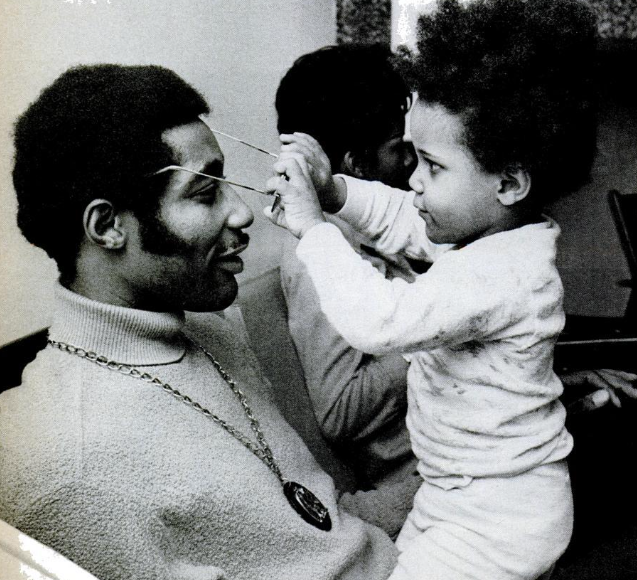 After a circuitous entry into the NBA, having played for the Pittsburgh (then the Minnesota) Pipers, Connie Hawkins played seven seasons before retiring to Pittsburgh, establishing the Connie Hawkins League in the city, and eventually being inducted into the Naismith Basketball Hall of Fame. (Life Magazine, May 16, 1969)
As for Hawkins, he inspired an entire generation of players, including fellow ABA player Julius "Dr. J" Irving, who became the league's best-known player before his NBA years. The ever-humble Hawkins, when asked about Irving being nicknamed "Little Hawk" after him, said nobody moved like Irving, who he considered the greatest dunker of all-time.
The years changed Connie Hawkins. The adversity had shaped him. It wasn't the path he ever imagined for himself, but he'd got there. He achieved his lifelong dream to play in the NBA. Were there regrets? Maybe. But as Hawkins reflected, "All the trouble I had to go through made a man out of me."
After retirement, he remained in the Pittsburgh area. The renowned and competitive Connie Hawkins League was established in the city and lasted for decades. In 1992, he was inducted into the Naismith Basketball Hall of Fame, a call that brought him to tears. He died in 2017 at age 75. That same year, sportswriter Tim Bontemps noted that despite the ABA being long gone, it remains the soul of the current NBA.
While Pittsburgh remains a professional basketball desert (hopes for an expansion team in the hotter-than-ever WNBA fizzled last year), for basketball fans living in Erie, lifelong dreams came true in 2008 when the professional NBA G League team, the Erie BayHawks, were established and played in our downtown arena. They ceased operations in 2021. But that, readers, is another story for another time.
Jonathan Burdick runs the public history project Rust & Dirt. He can be reached at jburdick@eriereader.com