Erie Artists in the Shadow of AI
Machines can mimic, but can they create? Erie artists weigh in on what's at stake
As big tech pours investment into AI, pushing for ever-greater efficiency, many people working in creative fields feel left in its data-center-shaped shadow. The rapid spread of generative AI content raises thorny questions about authorship, signaling a profound shift in how art is made and valued.
In some industries, AI is being used productively, including medical research, insurance processing, and tax services, where it can improve efficiency. In other areas, the benefits are less clear. For many artists, it's difficult to visualize an ethical and useful future for generative AI.
That uncertainty feels especially close to home in Erie, a small, working-class Great Lakes city with a growing creative community. For local artists, the risks are no longer theoretical.
Adam Calfee is a partner and co-founder of MoreFrames Animation, based in Erie. He earned a Bachelor of Fine Arts in Animation from Edinboro University in 2008, when the work was still hand-drawn on paper and individually scanned onto VHS tape. More than 15 years ago, Calfee and his classmates, Gus Trauth and Jordan Held, launched MoreFrames. Since then, the studio has worked with major clients including A24, Adult Swim, National Geographic, Vice, and most recently, Marvel Snap.
After years of working in animation, Calfee warns that "the creative industries are in real danger." What worries Calfee isn't just the technology itself, but how quietly it's becoming the baseline. "It's an extremely powerful and fascinating technology, with horrifying implications," Calfee said. "Companies are embracing AI while pretending they're not – putting on a public face that claims to support artists, while quietly shoehorning AI into every possible crevice."
Since accessible generative AI models entered the mainstream, artists at MoreFrames have noticed a shift in client expectations, specifically in assignments that, as Calfee put it, aren't humanly possible.
"Companies say 'don't use AI,' but their expectations assume that you will. The window of what's considered possible is shifting and artists who don't use AI risk being pushed out." In one instance, a company requested that MoreFrames animate a video, using images generated by AI. Calfee said the images were "totally useless." The studio declined the project. "It was surprising and disappointing to see this from such a big company with the resources to pay for real art," he said.
In addition to questions of quality, AI raises ethical issues because its content is drawn from creative work published online. This work is then scraped into massive datasets used to train generative AI models.
"Exposure is good – what am I making this work for if not to be seen? I want to put my work out as widely as possible, but that also makes it vulnerable," Calfee said on pushing his animations out online. What tech companies often frame as innovation feels, to many local artists, like exploitation, work absorbed without consent.
As artists recognize their work inside these systems, some turn to the courts. Artists and writers have filed multiple lawsuits against companies accused of scraping their work to train generative AI. Most recently, Anthropic agreed to a $1.5 billion settlement with authors whose works were used without authorization, marking one of the largest copyright-related settlements in U.S. history.
At the same time, the economic promise of generative AI is showing signs of strain. The MIT Media Lab surveyed more than 300 businesses using generative AI tools and found that only 5 percent saw return on investment. The remaining 95 percent failed to see a profit. Even though most users see minimal profit, major tech companies keep encouraging businesses to adopt generative AI.
Beyond legality and ethics, many artists argue that AI-generated art lacks the depth and nuance that characterize human-created artwork, shifting the way art is perceived.
Andi Graham, an Erie-based illustrator, is concerned about the quality of AI-generated imagery, the risks of people being misled by fake visuals, and the broader appreciation for human creativity.
"New technology will always replace something. Jobs will be lost, and maybe new ones will appear," Graham said. "But the real victims are the people who are skilled at doing it the long way – the ones who understand the craft, the effort, and the nuance behind it."
When it comes to AI-generated art, Calfee and Graham agree: it's often recognizable, flat, and futuristic in a way that feels mechanical. Some have dubbed it "AI Slop," a phrase Merriam-Webster named the 2025 Word of the Year.
"I hope people understand the time and effort that goes into creating – it's not something that should be churned out of a database," Graham explained. "AI imagery is soulless – it's nothing without the artists who made the original work first."
Calfee warns that AI endangers the very currency of creativity, making it harder for artists to find paid work, keeping the starving artist trope alive.
"Artists will still know how to make art. What's at risk is the infrastructure that makes it possible for artists to earn a living," Calfee said. "I'm trying to make a career out of this. I have a family to support. I rely on the infrastructure to be there to do work that has value, and it won't have value anymore."
Research shows that these platforms don't just stumble – they trip spectacularly, and often. Popular AI tools like ChatGPT and MidJourney exhibit harmful flaws, including racial and gender biases, factual inaccuracies, and cybersecurity risks.
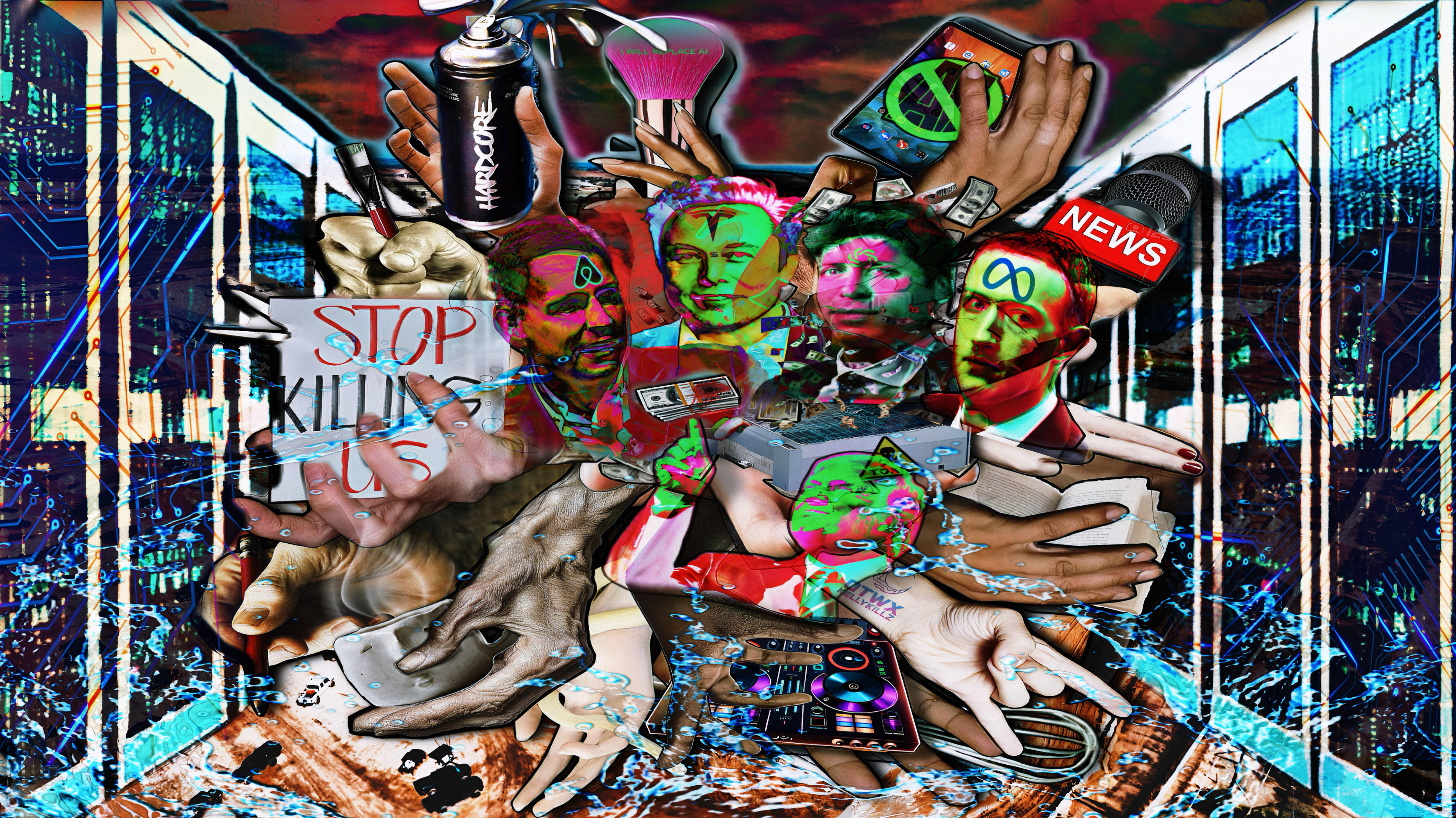
According to the artist's statement, "This digital collage critiques the fusion of tech and power, revealing the influential CEOs shaping our future. Beneath the surface of innovation lies a complex web of government policy, wealth, and unchecked ambition … As AI takes center stage, we must remember that behind every machine is a decision made by humans, at the expense of the environment and human creativity." (Artwork: Savannah Wilson/KellyKillz)
Erie-based digital artist Savannah Wilson (KellyKillz) is particularly concerned about the implications of generative AI being built without the input of artists and marginalized communities who have historically been excluded from tech developments.
"We can't ignore that these systems are built on racism and misogyny," Wilson said. "Artists are being left out of these conversations, and it's intentional. We need to reclaim these spaces and make sure our voices are heard."
Wearing a black T-shirt featuring "Self-Love," a design she created after noticing a lack of representation of Black women in online art, Wilson explained that her career in digital art began unexpectedly, with a silver Nintendo DS and a stylus.
Today, Wilson works across digital platforms including, PicsArt Pro and CapCut, and selectively uses Artlist AI Animation to bring her illustrations to life, "infusing perspective and soul." But Wilson maintains firm boundaries around how her data is used. She has disabled ChatGPT's "improve the model for everyone" setting, which, according to OpenAI, means her interactions "won't be used to improve ChatGPT."
She also harnesses generative AI to satirize its gatekeepers, weaving figures like Elon Musk and Sam Altman into her works. In "Decoding The Future Of AI," a striking digital collage, she "critiques the fusion of tech and power… Beneath the surface of innovation lies a complex web of government policy, wealth, and unchecked ambition."
"I stand in both perspectives and look at all sides of the issue. AI is here, and we need to think about how we engage with it," Wilson explained. "As AI takes center stage, we must remember that behind every machine is a decision made by humans, at the expense of the environment and human creativity."
Another area of concern is the environmental impact. These large-scale data centers rely on fresh water to cool labyrinthine halls of humming servers, consuming millions of gallons daily to prevent their equipment from overheating. The Lincoln Institute of Land Policy found that large data centers require up to 5 million gallons of water every day. That's enough water to meet the needs of 50,000 people, comparable to Millcreek Township.
According to the Food and Water Watch, generated AI images consume thousands of times more energy than a standard text search. The expansion of AI data centers across the country has raised concerns in Great Lakes communities, where fresh water is both a shared resource and a point of pride.
Popular AI platforms like Claude (Anthropic), MidJourney, OpenAI, and Perplexity AI extract value from artists and natural resources, and often sideline the very people whose labor and creativity make it possible.
"The law simply hasn't caught up yet. I think the solution, if there is one, is going to be heavy regulation," Calfee said.
As artists grapple with these changes, policy protections remain limited in the United States. While Europe has enacted guardrails for AI oversight, recent federal actions have signaled resistance to state-level AI regulation.
As generative systems reshape creative labor, the question isn't what AI might become – but who it serves, who it harms, and at what cost to communities like Erie.
Julia Carden can be reached at juliacarden91@gmail.com