True Community Theater: A History of the Erie Playhouse
The dramatic evolution of Erie's local theater scene

In 1819, when Erie was still a rugged settlement of less than a thousand, an Irishman named William Hughes opened a hotel at the old Bell House on the corner of French and Sixth streets. He reminisced fondly about his younger years as an actor and soon organized a "dramatic company" for Erie's young men. Before long, they were putting on performances in a nearby building a few blocks north. It wasn't for fortune or glory. It wasn't to pay their bills. The creative process and community were the point.
Over two centuries later, that creative spirit remains in Erie. There is no shortage of live performances around the city. One can find musicians performing on stage nightly, stories interpreted through dance by numerous ensembles, interactive dinner theaters at The Station and Peek'n Peak, and explorations of life expressed through humor at events organized by Flagship City Comedy and Kellar's, A Modern Magic and Comedy Club.
There is something for everyone on the city's stages. You can find theaters performing everything from Rodgers and Hammerstein classics to the more gritty and quirky to the locally written and experimental. Want to watch professionally performed Broadway favorites like Music Man, Kinky Boots, Clue, and The Book of Mormon? Warner Theatre's Broadway Series has you covered in 2026.
On the local level, though, is where one truly discovers the depth of Erie's theater scene. Many beloved institutions have come and gone over the years. Some, like the beloved All An Act Theatre Productions, have recently dealt with challenges beyond their control, leaving them without a home – but with a hope to return soon. Still, the local theater scene remains thriving and ambitious.
The Performing Artists Collective Alliance (PACA), formed in 2012 and operating out of the iconic Mayer Building at 1505 State St., is a prime example of this ambition with over a dozen productions scheduled for their 2026 season (pro tip: check out their FlexPass punchcard, which will get you into any eight of your choosing and save you 50 bucks). First though, beginning on Nov. 13 to close out their 2025 season, PACA will stage Journey to the Poles of Inaccessibility, described as a "fantastical rom-com" that is "Indiana Jones meets Around the World in 80 Days." They will then close out their year with their Holiday Extravaganza Dec. 18-20.
Footlights Theatre, wrapping up its 50th year of youth shows and programming, put on outstanding productions of Beetlejuice Jr. and Madagascar Jr. over the summer at Strong Vincent Middle School, followed up by sold-out shows of the teen edition of Hadestown at the PACA building in October. In May 2026, their youth production of Puffs will debut at PACA, a Rosencrantz and Guildenstern-style Harry Potter parody that is a "tale for anyone who has never been destined to save the world." Meanwhile, Corella Productions, which offers children tuition-based after school programs and summer camps, just staged an early-November production of Matilda Jr. at Cathedral Prep.
Then there is Dramashop. Their mission is to "provide entertaining and provocative theatrical experiences designed to challenge and engage the Erie community." They have produced countless shows over the past decade including their annual Originals Festival which highlights locally written, directed, and performed one-act shows. For those who like to go deep into the weeds, they also hold their monthly dramatic works discussion club called SCRIPTED at Werner Books and Coffee.
Newest to the local scene is the Tethered immersive theater company, founded in 2023 by award-winning filmmaker John C. Lyons. They just wrapped up their second production, which transformed the Erie Maennerchor Club into a walkthrough set piece, exploring the fragmented nature of trauma and memory.
If your theatrical thirst still isn't quenched, you can travel south to Meadville where they have the historic Academy Theatre, the Meadville Community Theatre, and the youth-centered French Creek Community Theatre, which has productions of Newsies, Moana Jr., and Grease on the slate for 2026. One also cannot discuss local theater without mentioning the many college and high school productions throughout the region.
Then, of course, there is the Erie Playhouse, a cultural staple and one of the oldest community theaters in the United States. Before the Playhouse, there were many troupes and companies performing throughout Erie at venues such as Farrar Hall and Shea's Theater. Perhaps the best-known of these predecessors was the People's Theatre, which was organized in the 1880s as "friendly competition" but, the founders stressed, not a rival to the already established Erie Opera House.
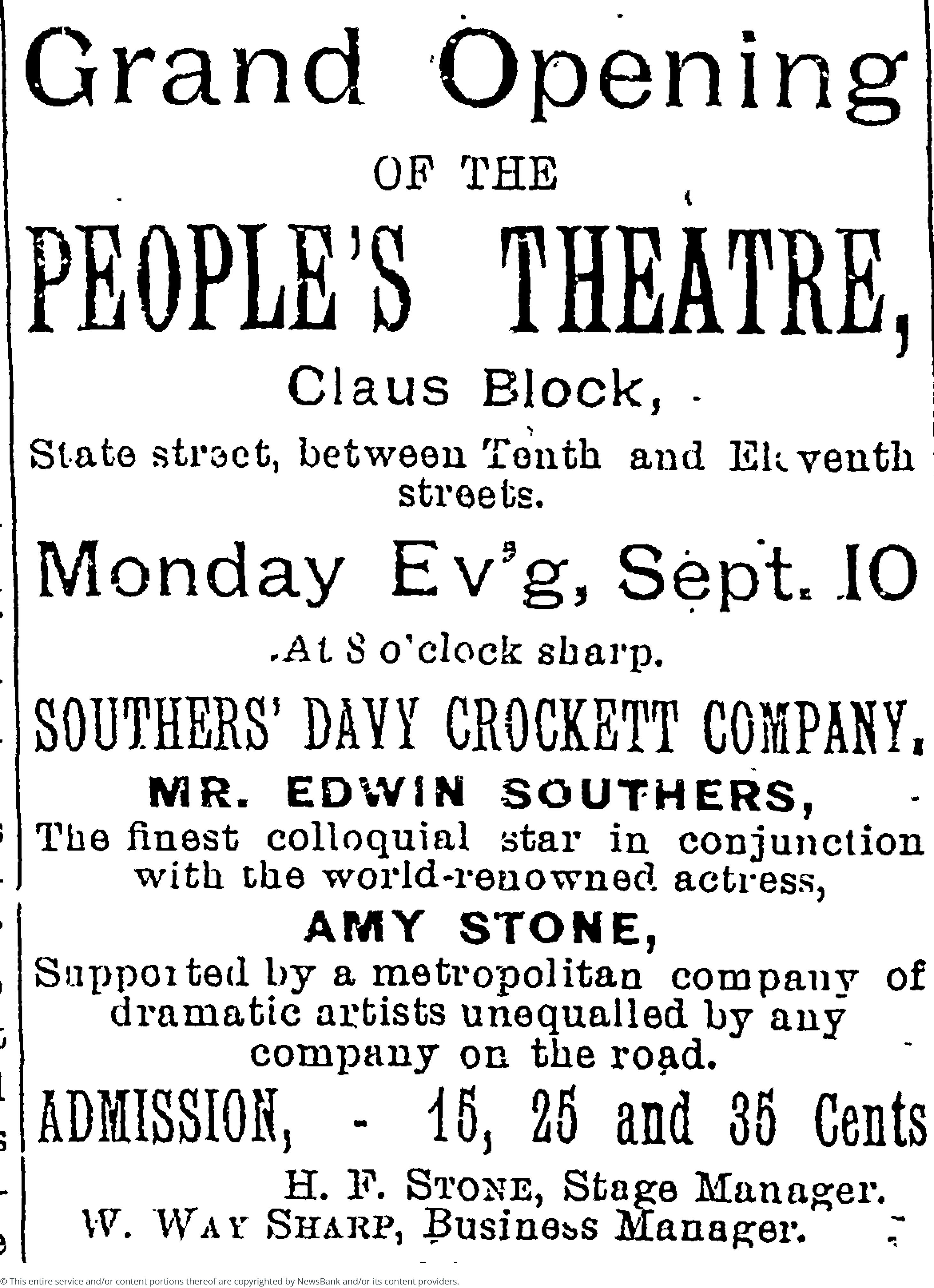 The history of community theater in Erie is a dramatic tale, from its scrappy beginnings as the People's Theatre through many changes, scandals, and triumphs into the rich landscape of performance groups like PACA, Dramashop, and the Erie Playhouse.
(Erie Daily Times - September 7, 1888)
In the mid-1880s, renovations for the People's Theatre were initially planned within a skating rink. They would build a stage, install electric lights, and construct a movable floor to cover the rink when needed. Plans shifted though when in 1888, proprietor H.V. Claus secured a "handsome little hall" on State Street between 10th and 11th streets for their productions. Its soft opening was that September with a performance of the drama The Railroad of Life. Other shows performed that opening week included The Silver King, which brought the crowd to tears, and Davy Crockett, which resulted in a lot of fear. The production used living wolves.
"Quite an exciting scene took place at the People's Theatre last evening," reported the Erie Daily Times. "One of [the wolves] escaped, and bounding over the foot lights, ran down the aisle." An actor shouted to the audience not to be afraid and simply grab him. Instead, there was a stampede towards the door and a "small sized panic" before the wolf was caught a few minutes later. The play proceeded and, besides the whole wolf incident, was well-received. The Erie Daily Times called the opening week "a prosperous one" that "demonstrated beyond a doubt that the city can support two places of amusement."
Shortly after this, an out-of-towner named Mark Ferrell arrived in Erie. Described as a "pleasant gentleman" with a gray beard and jolly temperament, he offered to lease the building from Claus and take over management duties of the People's Theatre. Ferrell explained that he was a "veteran thespian" of over 50 years whose father had managed Her Majesty's Theatre in London, England. Ferrell himself made his stage debut there at age 12, he said. He recounted how after arriving in the United States at 18, he then spent decades traveling the New England circuit as an actor and manager, only taking a brief hiatus to serve in the Civil War under General Judson Kilpatrick.
"[T]here is not a professional man in the country who has not heard of me," Ferrell told the Erie Daily Times after closing the deal. His motto? Good shows at popular prices. Extensive construction continued under his watch over the next two weeks, transforming the theater into a "very cozy temple of amusement." He hired an orchestra and announced their October show as the romantic military drama Last Roll Call. In the cast of 30, two were professionals while the rest were local amateurs. Tickets ranged from 10 to 30 cents.
The morning of the show's opening arrived. Ferrell though was nowhere to be found. Rumors spread quickly. Some said he had skipped town. One business owner claimed to have met Ferrell while he was using another name. Whatever the case, besides the upcoming show, he also owed on his rent, owed tabs at nearby restaurants, and had about $25 of the theater's cash (the equivalent of about $850 today). Claus was baffled. He postponed the show.
"Duped," the Erie Daily Times wrote. "Ring down the curtain." A former Opera House manager said he had witnessed similar con artists come into Erie for a few days and split, but never one who brazenly duped the entire community for weeks. Still, the shows had to go on. A few days later, with Claus temporarily taking on managing duties, they continued their planned productions.
"Old man Ferrell may have been a swindler and all that, but he had the right idea of what a theatre should be," the newspaper noted following a nearly sold-out performance of A Wife's Peril. They followed this up with equally successful productions of Erin-Go-Braugh and Lost in London. The Erie Daily Times called it "an assured fact" that the People's Theatre would be successful, and for many years it was.
Decades later in Jan. 1916, a communal theater organization called the Little Playhouse opened at North Park Row's Reed Hotel. Many of those involved had ties to the old People's Theatre. "Erie will have one of the first of the genuine community theaters in America," reported the newspaper. This was part of the experimental Little Theatre Movement, described by an Erie reporter as a theatrical crusade where "no storeroom, no big barn, no abandoned church was safe from invasion by an earnest group of neophytes who knew little of the theater and yearned to do something to improve it."
Henry B. Vincent, already a well-known composer and pianist in Erie, was managing director. He remarked that the Little Playhouse would be dedicated to the "encouragement and development of whatever latent talent there may be in the city" with the "entire absence of commercial considerations." There would be, he stressed, "no element of private gain."
"It will belong to the people and to no one person or group of persons," the organization stressed. Ticket prices would be affordable, local talent would be nurtured, and it would, with time, be entirely self-supporting. They desired to build a community where "Erie painters, authors, players, and musicians" could "always find an opportunity to be heard or seen." It was all about the community, the people.
Opening night was set for Jan. 18 with three plays performed: I'm Going by Tristan Bernard, Galatea of Toy-Shop by Evelyn Sutherland, and Sunset by Jerome K. Jerome. It was described as a "brilliant first night" with the "excellent acting of amateurs whose work approached the professional" and "a director of such ability and of such artistic taste."
By April, they achieved one of Vincent's goals: putting on an entirely original Erie play. Written by Carrie Hulse-Petriollo, it was titled In Capri and set in Italy. A local artist, Edgar Kowalski, painted the scenery and the top-billed cast included locals Iona Phipps, Bertha Liebel, and Katherine Scott. The "charming little play" was very well received. After closing for the season that May, the local press had deemed them a success.
In 1919, they rebranded as the Community Playhouse after reopening following World War I. They moved to the Keystone Brass Foundry (the current YMCA building) and, described as "rich in ideas, but poor in purse," they shifted focus to more commercial productions. They never intended to do more than break even, but they did need to keep the lights on. It paid off. By 1923, now being referred to as the Erie Playhouse, they were described as "unusually capable and experienced players" and considered by many to be one of the premier community theater groups in the country.
Much to their surprise though, their building was sold a few years later, so they spent about a year performing out of the Columbia Theatre on West Eighth Street while Vincent raised funds for a permanent home. In July 1928, work began on their new theater on West Seventh Street. It opened the following year to high praise and being "worthy of the highest ideals of the most ardent Playhouse enthusiast."
In 1940, Vincent created the youth theater branch of the Playhouse. The following year, though, he died unexpectedly of a heart attack. "[Perhaps] we do like to believe in a Heaven where everyone does what he or she loved best to do on earth," the Erie Daily Times eulogized, noting he was "the personality behind the success of The Playhouse." Soon after, they put up his portrait in the Playhouse, inscribed beneath it: "This theatre is devoted to the making of happiness."
Jack "David" Lewis, one of the leading players, then took over for two years. When he left to pursue acting opportunities elsewhere (including Hollywood), the Playhouse ceased operations for the next few years due to World War II. According to accounts from the time, supplies and gas rationing contributed to this closure, but also the lack of male actors. This temporarily left Erie without any live theater.
In Sept. 1946, it reopened under the direction of L. Newell Tarrant. During the Tarrant years, there was a shift towards recruiting professional actors from around the country. Some future big names came through the Erie Playhouse.
In 1948, a fresh-out-of-college Anne B. Davis joined as an apprentice where she learned "every aspect of production." In the 1950s, Jerry Stiller spent two years as a player. He'd learn his lines on Presque Isle's beaches. Stiller recalled the Erie Playhouse as a "cultural oasis" and, from his own recollection, he really learned to act for the first time alongside Henderson Forsythe – future Tony-winning stage actor and a decades-long soap opera star – who taught him the meaning of trust onstage (and how to drink boilermakers downtown). Other names from this era included Rue McClanahan, Walter Matthau, Eli Wallach, Frank Langella, Ned Beatty, Dom DeLuise, and Monique van Vooren as well as retired boxer Rocky Graziano and future author Robert Ludlum.
In 1962, it was announced that Tarrant had accepted a one-year "special professional assignment" in Hawaii. Following Tarrant's departure was a brief hiatus, followed by a little over a year where Lenny Edelstein called the shots, a decade under Bill Cohen, and then over three decades under David Matthews. During these years, Matthews, the board, and staff all worked diligently to restore their shared vision of the Playhouse being a community theater. The Youtheatre was introduced while classes, workshops, and camps were offered as educational outreach.
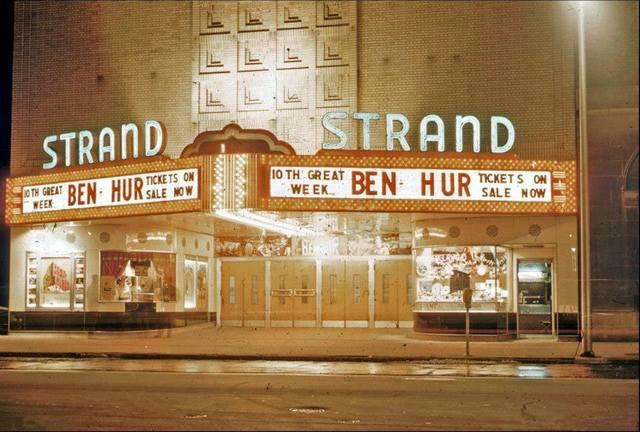 The original Strand Theater built in 1948 would eventually become the home of the Erie Playhouse, when it was purchased by the group in 1983 – it has been producing local performances there ever since. Coming up in November and December, catch the Youtheatre show Emma! A Pop Musical and the Mainstage modern classic Frozen: The Broadway Musical. (Photo: Cinema Treasures)
In 1983, they purchased the old Strand Theatre on West 10th Street, its current home. After a Pittsburgh Press reporter watched a performance of The Rainmaker there following renovations, he argued that the Playhouse was "competing for the title of best community theater in the country."
"There's something the community theater has [that] the professional theater doesn't have," Matthews told United Press International. "They do it out of love." The professionals, he felt, were often more concerned about how much they were being paid and how long the show ran. "For a town that they say is beer and bowling … the Playhouse is doing real well," he added.
Following the departure of Matthews, executive leadership has included Almitra Clerkin, Kate Neubert-Lechner, and, since 2023, Zach Flock with longtime playhouse legend Richard Davis as artistic director. Needless to say, you could, quite literally, fill an entire book covering the long and spellbinding history of the Erie Playhouse.
The Erie Playhouse remains more active than ever. For youth, they offer Showstoppers show choir and continue to offer summer camps along with acting, voice, and improv workshops. In 2024, they even offered a workshop on stage combat. On the mainstage, the Playhouse just finished a successful run of The Elephant Man. From Nov. 7-16, they will be putting on a youth production of Emma! A Pop Musical, a contemporary adaptation of Jane Austen's classic novel, directed by Youtheatre director Ahnika Lexvold. They will then close out the season in December with Frozen: The Broadway Musical.
The 110th Season in 2026 promises to be an exciting year, too, with productions of Mean Girls, Junie B.'s Essential Survival Guide to School, A Doll's House, Once Upon a Mattress, 1776, Hairspray, Come Far Away, Charlie and the Chocolate Factory, and Over the Tavern.
So, as winter approaches and the days shorten and some of those seasonal blues begin to set in, find the stage where the stories and people speak to you. As my own father Doug Burdick, who oversaw the French Creek Community Theatre for decades, always said, that's truly what it's all about: the people.
Frozen runs weekends from Dec. 5 through Dec. 28 // Erie Playhouse, 13 W. 10th St. // For tickets and info, visit: erieplayhouse.org
Jonathan Burdick runs the public history project Rust & Dirt. He can be reached at jburdick@eriereader.com