A Bigger, Better Blasco: Renovating the Mead Children's Library
Changes highlight accessibility, engagement, and built-in learning

My children are always at our downtown Blasco library and there's always something to keep them busy. It can involve Lego, storytelling, crafts, or games. Sometimes they host film screenings. One time, we built cars out of cardboard, and they sat in them during a film screening. The displays are constantly changing as well, and not just for Christmas or Halloween. You'll find curated collections highlighting Ramadan, Latin American history, and kid-friendly cookbooks. As you enter the kids' area, the artwork in the glass enclosure is constantly revolving, showcasing youthful creativity from throughout the region. The amount of work on display always impresses me – and it's about to get much more ambitious.
In 2024, the Mead Children's Library received nearly a million dollars from the Pennsylvania Department of Community and Economic Development (DCED) to "enhance the library's ability to provide educational and community programs, create a more engaging environment for young learners, and improve accessibility and functionality for all patrons," according to a government media release. By the time I met with Jessica Spitulski, the Erie County Public Library's executive director, in mid-May, that project was well underway.
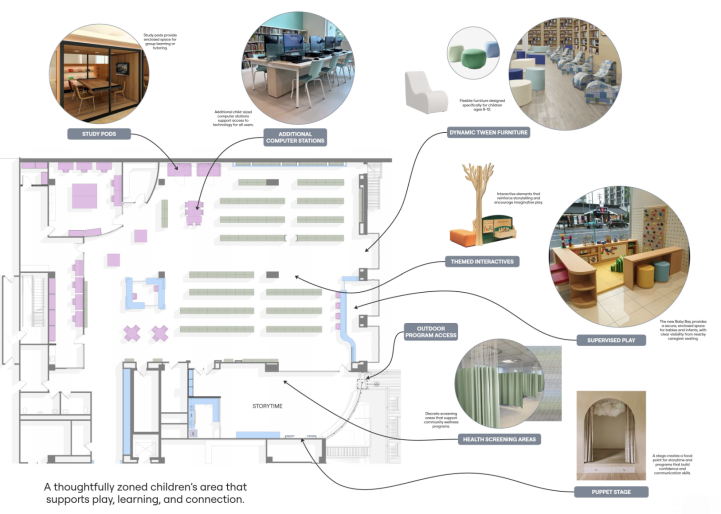
"Something that was very important for me to include was learning when you don't realize you're learning," says Spitulski. "We will have an info desk, but we'll give kids the first shot to find things on their own through a map. So, they're not just learning how to use the library, they're also learning navigational work, and how to follow directions." Once they're on their way, "it is designed to be like a neighborhood," according to the director. There will be a fiction forest, a baby bay, a nonfiction neighborhood, and tree-shaped architectural flourishes – all encouraging kids to explore with purpose and independence.
The baby bay will include a wraparound workstation, so that parents can sit on the outside of the play space with their laptops while their children are in view. It will also be gated, "with one side devoted to playthings and the other for books and literacy-related materials," according to Spitulski.
Other improvements to the main space will include study rooms and small meeting spaces for therapists, tutors, and homeschooling parents. Colorful elements will be added to the ductwork on the ceiling, and the information desk will be made more inviting, open, and accessible. A special space for older children is also in the works. "We have an age group of 8 to 10-year-olds who are not quite ready for the teen space," says Spitulski. "That's something that was identified in our public feedback as missing – a space designated for those kids."
Those public meetings ultimately attracted comments from about 60 families, allowing the library staff to assess what was most important to their visitors. Making the bathrooms more user-friendly and accessible was cited as a specific need, for example.
Perhaps the most impressive addition will be an outdoor deck, accessible through the back of the Joan Spiegel Children's room (i.e., the crafting and activity space). This partially covered area will provide "opportunities for weather learning and to see out on the bay while we talk about the history of the area and the night sky," according to Spitulski. Back inside the Spiegel room, you'll find a kitchenette for cooking and nutrition instruction, a retractable stage for puppet shows, and triage curtains to make their free health clinics more private and multi-faceted.
The DCED funding for the project comes from the American Rescue Plan Act, which was passed in 2021 "to address issues related to the continuation of the COVID-19 pandemic," according to the Department of the Treasury. Spitulski sees a clear connection between the library's mission and the aftermath of COVID-19: "Libraries have always been focused on children's literacy, and that's especially important now," says the director. "Children who were in their formative learning years when schools were closed are reaching a critical point. If they have not learned to read successfully by third or fourth grade, they will struggle for the rest of their lives. We are trying to build a space where those kids who were a bit left behind by the COVID disruptions can have the opportunity for a successful future."
Barring unforeseen construction delays, the new Mead Children's Library should be open this September. It won't be long before our young ones are wandering its updated halls, with a little more excitement and a lot more independence than the last time they visited.
A pre-renovation walkthrough video of the Mead Children's Library can be viewed on YouTube.
Dan Schank can be contacted at danschank@gmail.com