An Interview with Writer Eugene Garcia Cross
Fiction writer and screenwriter to visit and read at Behrend
THURSDAY, APR. 18
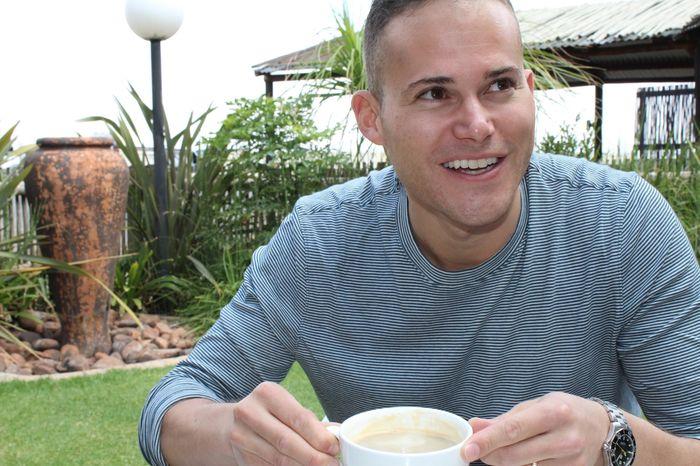
Ahead of his visit to Penn State Behrend, fiction writer and screenwriter Eugene Garcia Cross, an Erie native, had an email discussion with Abby Walter, a senior BFA in Creative Writing student at Behrend, about his work. Eugene Garcia Cross's reading will take place Thursday, Apr. 18, at 6 p.m. in Behrend's Smith Chapel. The event is free and open to the public.
Abby Walter (AW): Would you please provide an introduction to yourself and your writing for readers unfamiliar with your work?
Eugene Garcia Cross (EGC): I'm an Erie native and fiction writer. Although I've been writing creatively since I was little, my interest and love of it really sparked as a sophomore at the University of Pittsburgh. I enrolled in an Introduction to Creative Writing class as an elective and from the first day I was hooked. Following graduation, I stayed on at Pitt to complete my MFA in Fiction. My first love was the short story form and I worked hard on those for many years before finally beginning to publish in small online and print literary journals. After a bunch of years churning out stories, I was able to put together twelve that I was proud of. That manuscript ultimately became my first book, Fires of Our Choosing, a collection of short stories published in 2012. I would categorize my work as regional literary fiction set mainly around the area of Pennsylvania where I was raised.
AW: What are some of your goals with your writing? What do you hope to accomplish with your readers?
EGC: One major goal I set forth is to be entertaining and to captivate a reader's attention, especially in a world filled with endless diversions. I'd say that another goal is to inspire empathy and awareness in the reader. There are so many stories out there and so many issues, that even the most civic minded individuals can sometimes find themselves unaware of a particular population in our society. Art in general and fiction in particular have always been one of the most effective ways to not only introduce us to different groups of people we might not have encountered in the "real world," but also educate us about the particular challenges those groups might face. Writing "Miss Me Forever" provided me with the incredible opportunity to educate myself about the Lhotshampa community (Bhutanese people of Nepalese descent), a group which the novel's protagonist Tulsi is part of.
AW: Have your goals and priorities as a writer changed since you began writing?
EGC: My goal of entertaining readers and encouraging empathy among them has remained largely the same over my career. The process of writing, at times, has become somewhat more difficult for me. I don't know if it's self-editing or just being hard on myself, but I find it takes me a bit longer to begin and finish prose pieces than it used to.
AW: What is the process of developing a story like for you?
EGC: The stories I've written that I feel have stood up the best usually began with some fixation on my part. A shred of dialogue, an image I can't shake, a character that won't stop nagging my imagination. Once I'm thoroughly obsessed in that way, writing is the only way to free myself. I used to write mainly at night, when I'd finished my grading and other work duties. Now I have three kids and so time is at a premium. I'll write in the mornings or afternoons if I can. And I need a dedicated chunk of a few hours. I have friends who can piecemeal exquisite stories and poems out of fifteen- and twenty-minute intervals throughout the day. Sadly, that's not me. And while I admire those writers who can outline and plan and use those tools efficiently, I find myself drawn to writing into the void. I used to tell my students that our subconscious is a far better writer than our conscious. I like to be surprised by what my characters will do and say and where they'll go when not tied down by my preordained plans. Finding those unexpected details as you go is one of the great joys of the process.
AW: Who are your greatest literary influences? Is there a difference you see between writers who have shaped your style and approach so far, and those you aspire towards?
EGC: There are so many writers I admire. Early on it was Raymond Carver, Tobias Wolff, Flannery O'Connor, John Cheever, Louise Erdrich, and countless others. I think, especially when I was younger, that my influences reflected themselves in my writing through that most flattering of ways – not-so-well-concealed imitation. As I was learning the craft, I simply mimicked those writers I loved. It's a useful exercise for anyone starting out. I recall a friend approaching me after I'd given a reading and saying something to the effect of: "Nice story. Richard Ford would like it back now." I remember being hurt, but he was right. The subject matter and style, all of it was my feeble attempt to write like a writer I loved. As you go on, you hope that mimicry will evolve into a voice and style of your own. Even when it does, we are indebted to those writers. As Cormac McCarthy said: "The ugly fact is books are made out of books. The novel depends for its life on the novels that have been written." We internalize our mentors and heroes and the works we adore. They shape us and the words we put down. The writers who've influenced me and those I aspire to are largely one and the same. But I've freed myself of any notion that those aspirations will be fulfilled. It's liberating to know that your heroes will always be your heroes for a reason, they're just operating on a totally different wavelength.
AW: Are there themes/images/events/character types that you find yourself returning to? Are you one to resist these tendencies, or do you try to embrace them in your work?
EGC: I hope that I've learned to embrace those tendencies and themes I just can't shake. I find that I write about losing a parent quite a bit. I lost my dad to cancer when I was young, and my mother was diagnosed with Alzheimer's in 2016 so there's a cathartic element to that topic for me. In other words, how would a character respond to something the writer themselves had gone through? How might I work this pain out through my art? Loss of family or connection to loved ones, through whatever means it happens to occur, is definitely something I've explored in prose.
AW: I've been reading your new novel Miss Me Forever for one of my writing classes this semester, and I've also read some of your stories from Fires of Our Choosing. Would you speak to the difference in approach between writing a novel and writing a collection of short stories? How different and alike are they?
EGC: That's an excellent question as the two forms have definite unique challenges. Writing a short story that doesn't turn out the way you'd hoped usually takes significantly less time than a novel so there's that element. That said, I think the short story form is so difficult since space is at a premium. In some ways it's more difficult than a novel in that you don't have the room to roam or meander that you might enjoy in a longer work. The famous quote is: "I didn't have time to write a short letter, so I wrote a long one instead." Brevity and compression and every word counting are challenges inherent to the short story form. Working on the novel, I enjoyed having a little more room to breathe and experiment, but that can be a trap in and of itself. I have a tendency toward tangent when speaking to someone in person and so monitoring that while writing is necessary for obvious reasons.
AW: What do you wish that you knew when you started writing that you know now?
EGC: Muhammad Ali's corner man Drew Bundini Brown was known to shout "Rumble, young man, rumble" when Ali was in the ring. I love that, but my advice to my younger self would be something quite the opposite. Maybe something more akin to "Go easy, you maniac. Calm down and enjoy things. It'll be alright." Starting out, I thought every word, every draft, every opportunity missed and every one seized would somehow dictate my future as the writer I dreamt of becoming. It's been almost twenty-five years since I sat in that Creative Writing class that changed my life, and somehow, I've been fortunate enough to make a living as a writer. Either by doing it or by teaching it or by helping others do it, but always in the realm of that blessed occupation of putting words on paper. I've made a million mistakes in the interim and am still hanging on every single day, learning from others, and reading and pinching myself that I somehow landed the job I dreamt of doing. But starting out it was all angst and sadness and indecision. So yeah, I'd love to go back and hear a future version of myself whisper something as simple as that. "It'll be alright."
6 p.m. // Smith Chapel, Penn State Behrend, 4701 Jordan Rd. // Free // For more info visit: behrend.psu.edu