Bird of the Month: Gray Catbird
Birds that meow (and are sometimes legends)
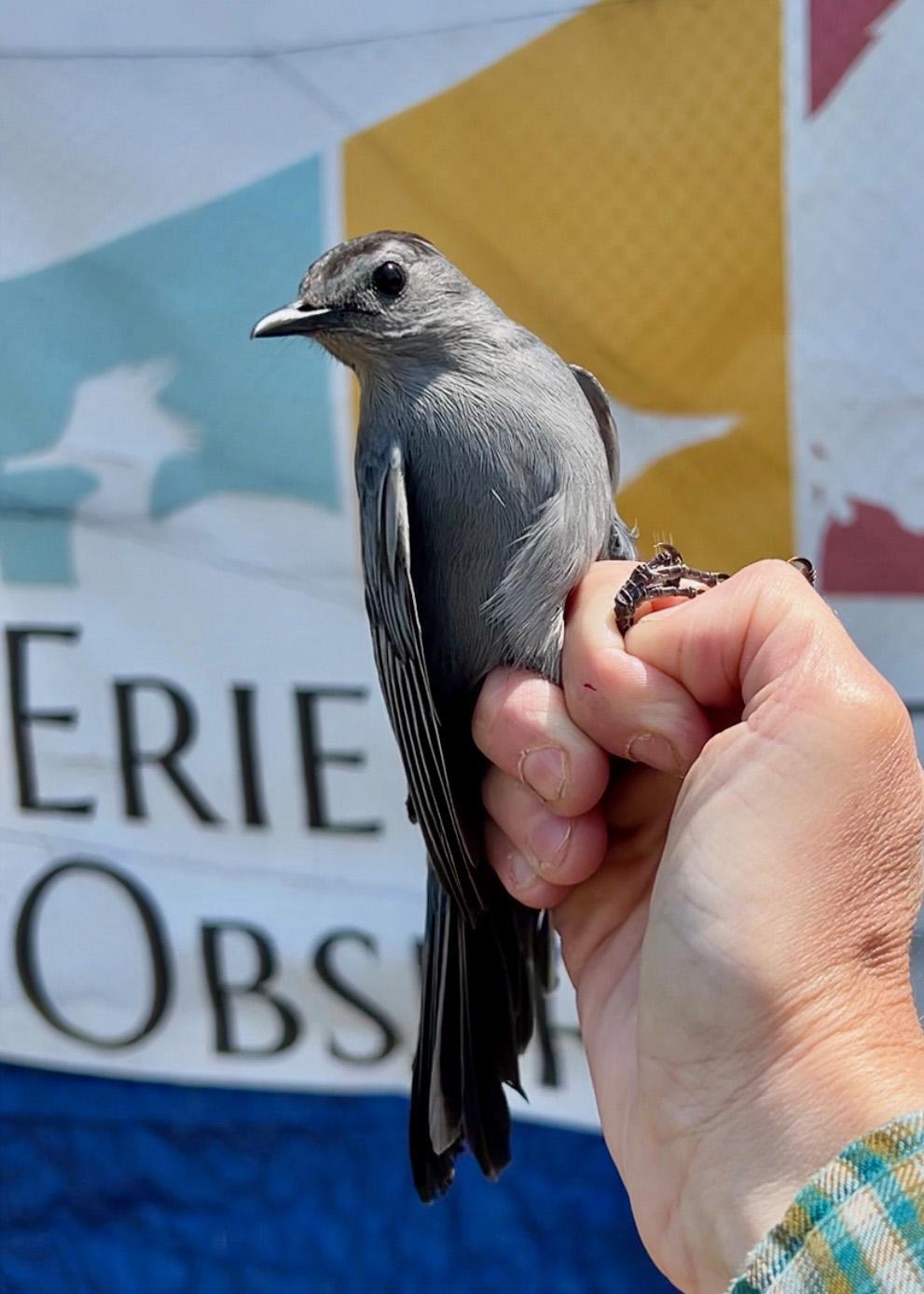
You hear a series of whistles, chatters, and squeaks all delivered in rapid sequence emanating from a shrub. You may also hear another bird that sounds somewhat like a Northern Cardinal or American Robin. If you don't know what you're hearing, just wait. A Gray Catbird will always give itself away with its signature squeaky meow call, from which it received its name.
Indeed, the Gray Catbird has quite a versatile vocal vocabulary. According to Cornell's Birds of the World, "Part of this ability stems from the structure of its syrinx. Both sides of this vocal organ are able to operate independently." Meaning the Gray Catbird can sing with two voices at the same time.
Although many may call Gray Catbirds drab in appearance, I prefer to call them understated in their plumage. They are overall gray in color and sport a narrow black cap. To spice things up a bit, they have a splash of rusty red hiding in what are called the undertail coverts, which is the set of feathers under the tail.
They spend their summers nesting across much of the United States and southern Canada, excluding the American Southwest. They are regular nesters in our area. In fact, one has nested in or near our backyard for a few years now, meaning they are a relatively easy bird to find since they occupy a variety of habitats from forest to urban spaces. They winter along the Gulf Coast of the U.S. as well as in the Caribbean, Central South America, and a small portion of Colombia.
They choose living shrubs, trees and vines for their nest, which the female mostly builds. Typically, the nest is about 4 feet off the ground but some have been found as high as 60 feet up. Their clutch can be anywhere from one to six eggs but three to five is found most often. They feed their nestlings insects and fruit, the same foods the adults eat.
Although common and mostly anonymous, some local Gray Catbirds are more famous than others. At the EBO banding station, Momma Catbird is a legend. Per Laura-Marie Koitsch, EBO's banding manager, she was banded in May of 2018 as a "second-year bird," meaning she hatched in 2017. Banders have welcomed her back every year. "She returns every spring around the same date she was banded and, in the fall, we usually catch her in the first week of September." They know she's a local breeder since she most often has a brood patch, a featherless area of skin on the abdomen of the bird that helps warm the eggs and nestlings.
"At a known age of 9, Momma Catbird was the oldest (known) bird at the banding station this year," says Koitsch. And since the longevity record for catbirds is close to 18 years, she adds "we are hoping she's with us for many years to come."
Famous or not, Gray Catbirds are, um, the cat's meow.
Mary Birdsong is the lead shorebird monitor for Erie Bird Observatory. Learn more at eriebirdobservatory.org. Mary can be reached at mbirdsong@eriereader.com