Bird of the Month: Purple Martins June 2026
Summer vacationers rent local digs
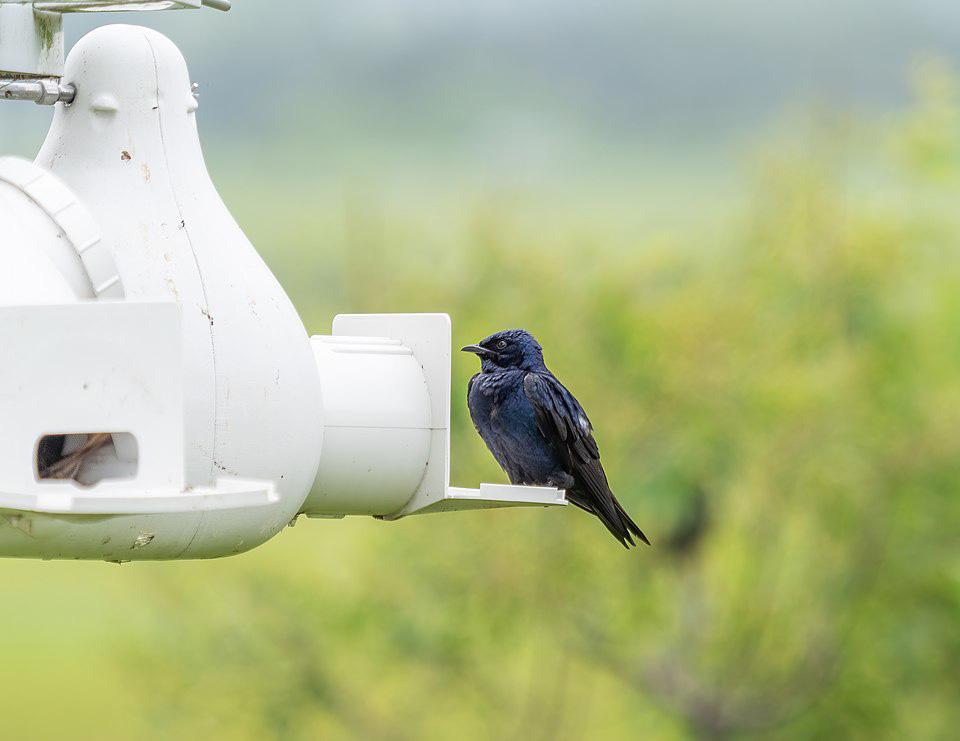
Approximately 350,000 people in the United States spend their summer doing nest checks, solving problems, and collecting data for science. They are called Purple Martin landlords.
Why? Because Purple Martins – a large, broad-chested iridescent blue or purple swallow with a slightly hooked bill and long, tapered wings – are entirely dependent on human-provided nest boxes in eastern North America.
Once nesting in natural cavities, Purple Martins started relying on artificial nest structures when natural cavities grew scarce. As early as 1712, Purple Martins occupied gourds in the Carolinas and Florida, according to Cornell's Birds of the World. Early naturalists reported Native Americans erecting gourds for Purple Martins, indicating the birds began their shift to artificial nest sites before the colonization of North America by European settlers.
Tara Dodge, education and member services director for the Purple Martin Conservation Association, tells me that she is fascinated by the fact that east of the Rocky Mountains, these birds are entirely dependent on humans to provide their housing. "So that means that every single martin you see in the sky was raised in someone's backyard."
The landlords of North America are doing their jobs well. According to Partners in Flight, a network of more than 150 partner organizations dedicated to conserving land birds and their habitats, there are approximately 7 to 9 million Purple Martins in the skies over North America during the nesting season. The eastern subspecies Progne subis subis comprises the vast majority of those numbers, according to Dodge.
With those numbers they should be relatively easy to spot. Males are metallic dusky violet or deep blue; females are similar but duller and less uniformly blue. Both have distinctly notched tails that help with identification when they are flying.
Purple Martins survive on a diet consisting exclusively of flying insects. In our region, a cold snap can take away their only food. Periodically, regional populations can be eliminated or reduced by cold weather. Landlords supplement their birds' diets with crickets, mealworms, or scrambled eggs (yes) in times when spring temperatures plummet.
Supplementing food is something these dedicated caretakers are willing to do. The use of backyard birdhouses and the frequent return of individuals to the site where they nested the previous year endears landlords to "their" birds.
For Julie Dell, a landlord in Edinboro, the fact that the same birds return annually is very rewarding. "It's so hard to pick one thing that I like the most about being a landlord. Having my yard full of wonderful birdsong all summer, watching courtship, young being raised right before my eyes, and laughing at their antics," all make the nesting season fun and rewarding. She also cherishes holding baby birds in her hand as she cleans their nests. She's proud that her activities contribute to understanding more about these birds and helping this species survive.
One of the mysteries of Purple Martin nesting behavior is why they use fresh green leaves in their nests. They place the leaves in the nest bowl over and around the eggs. Scientists still don't know why they do this. According to Dodge, the exact reason is still a bit of a mystery, but there are several theories. The most common are that the leaves may act as a type of insecticide, help regulate the temperature and moisture levels in the nest, or to help keep the nest clean. They may also use the leaves to help hide the eggs when they are off the nest.
But whatever their reason, Purple Martins are obviously fascinating birds worthy of our notice. Should you see a tall pole with white gourds or boxes in a rural backyard or at Presque Isle where they are situated near the Rotary Pavilion, at the west pier, and by the Tom Ridge Environmental Center, stop to watch them for a bit. They won't be here long – enjoy them while they occupy their summer vacation homes.
For more information about Purple Martins and view their highly popular live nest cam, visit purplemartin.org.
Mary Birdsong is the lead shorebird monitor for Erie Bird Observatory. Learn more at eriebirdobservatory.org. Mary can be reached at mbirdsong@eriereader.com