Gem City Style: Dr. Ferki Ferati, The Long Way Home
A 40 Under 40 catch-up
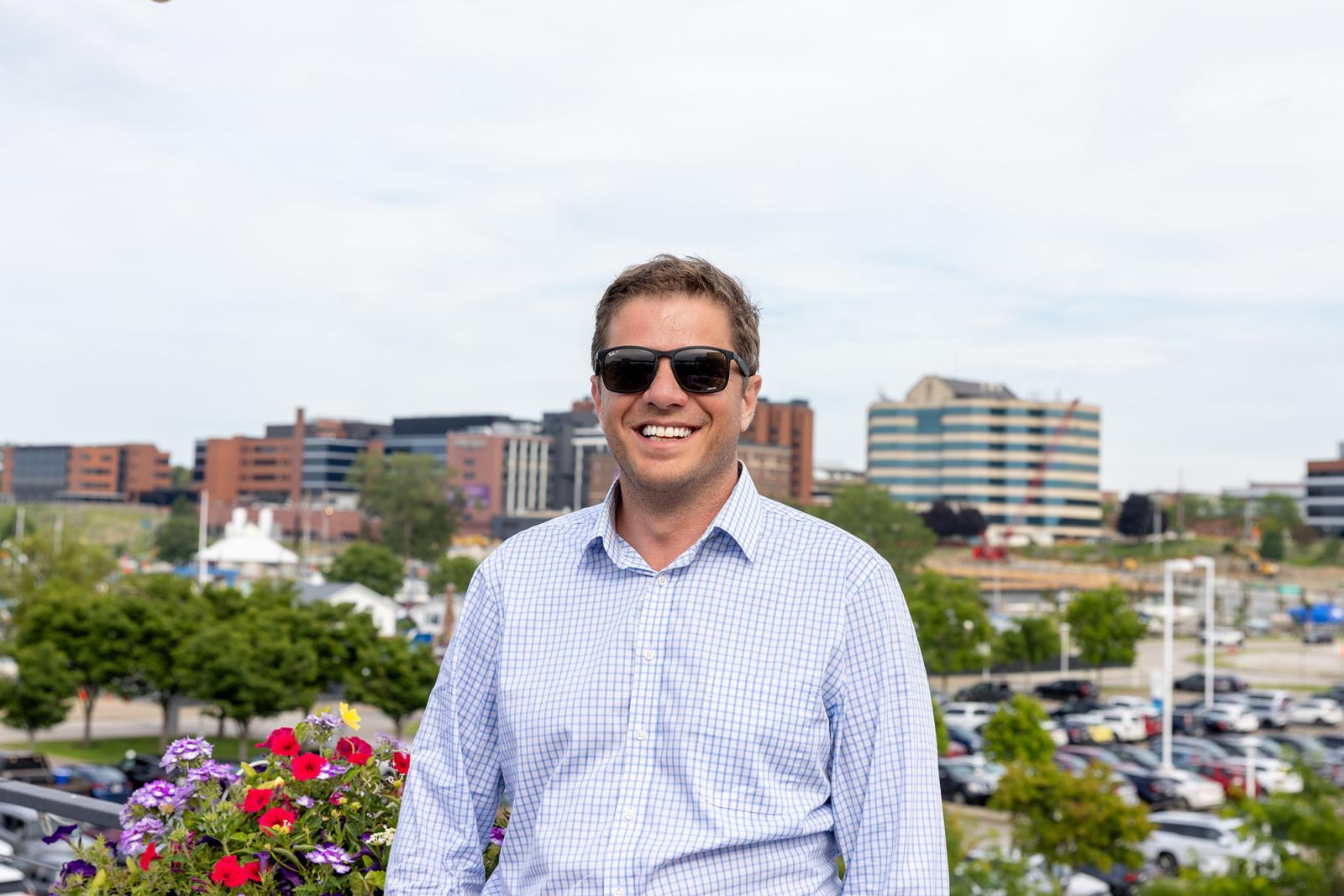
Dr. Ferki Ferati has brought a former President of the United States to Erie. Then he brought another one. He has brought Nobel laureates and some of the most consequential minds of our moment to a mid-sized city on the edge of a Great Lake, and then stood back and watched Erie pull its chair in close and listen.
Twenty-seven years ago, it was Erie that took him in.
That is the thing I keep turning over about Ferki. The man who now brings the whole world to our doorstep was once carried to that same doorstep with almost nothing, a refugee whose family had circled four American cities on a form and ended up in none of them. To understand the Jefferson Educational Society, the Global Summit, the leaders he has quietly helped grow, you have to start on a farm in Kosovo, with a boy who did not yet know the world could be any better than it was.
He was on the cover of this paper's very first 40 Under 40 issue, at age 29 back in 2013. When I asked what that meant, he did not reach for the easy answer.
"I don't believe I deserved it back then," he told me. "And I still kind of don't believe I deserved it." But it told him, he said, that he was at least pointed in the right direction, and that he should keep going. Keep swimming, was how he put it. And then, almost to himself: "We've swam pretty far."
Take me back to the farm, I said. What was that life like?
"I was a boy," he said. "And quite frankly, Jessica, I didn't like my life." They were poor in a way that is hard to render on a page in a country as comfortable as the United States. He remembers the winter of 1991, just before the family left for Sweden, when the food simply ran out. His father brought a guest home and asked his mother to make dinner, and his mother had to say there was nothing to make dinner with. The only cow they had died giving birth.
"Right? Died giving birth," he said. "And we had nothing."
He was 9 years old.
His father is the hero of his story, and he says so without hesitation, in a way that makes everything he has built since sound small to his own ear. His dad had been a foreman at a zinc refinery. When the regime forced the Albanian leadership out and installed its own, his father was one of the first nine men to walk off the job. The next day, he says, 50,000 people walked out behind them. "That's how the revolution started," Ferki says. "Everything I've done pales next to the sacrifices he made."
They had a single television back on the farm. Through it, this boy in Kosovo built a picture of America, and the picture was utopia. "It was Miami Vice," he says, laughing. "And Dynasty. That was our idea of reality in America." Don Johnson and shoulder pads. He understood the U.S. from programs, not as a place a person could actually go.
Then the family left for the first time. They spent two years in Sweden, and Sweden opened a door in his head. This was the early '90s, years before the war most people picture when they hear Kosovo. They had gone for the oldest reason there is, because there was no food and no work, the way many Kosovar families were quietly leaving in those years, heading west toward something better. He watched the 1992 American election unfold on the news there, and found himself, a boy with no stake in any of it, quietly rooting for Bill Clinton, the challenger, simply because he didn't want to cheer for whoever was already in charge of the world. "I wanted change," he says. What Sweden actually taught him was bigger than any candidate. "Oh," he remembers thinking. "You mean people have a say in what happens around them?"
And then they went back. That is the part that surprises people, because we tend to picture a refugee's path as a single straight line out. His ran the other way first. The family returned to Kosovo around 1994, the money they'd made was gone, and a teenage Ferki went to work to make more, selling cigarettes bar to bar and table to table for about three years. He was building a life in the country he'd been born in.
Then, at the end of the decade, the war came. And this time, leaving was not a choice.
When I asked how his family ended up in Erie, of all the places on earth, he stopped me before I could even finish the romance of the question.
"This is why you shouldn't make it about where you want to go," he said. "It's a study in letting the world come to you, and seeing where you can go." And then, plainly: he had never heard of a place called Erie in his life.
What happened was this. After the war, the family landed at Fort Dix, the New Jersey military base where the United States was processing thousands of Albanian refugees that President Clinton had cleared to come. And here Ferki insists on saying the part that many people in his position would let slide.
"We were lucky that we were white refugees," he says. His friend Felix spent 19 years in a refugee camp. Ferki spent six weeks there. "You know why? The color of my skin." He brings it up, he says, every chance he gets, because he had something working in his favor that doesn't work for so very many of the world's refugees, of whom there are tens of millions. "We should always pay attention to why I got here so fast," he says, "compared to somebody from Sudan who waits 20 years for clearances." It is the rare immigrant success story told by a man insisting you notice the unfairness that helped speed it along.
At Fort Dix, they were asked where in America they wanted to live. The family circled the only names they knew from the movies: New York, Los Angeles, Miami, Washington. Then a man named Mike Murnock, who ran the International Institute of Erie, told them something that changed everything by accident. New York, he said, is only 30 minutes away.
He meant New York State. He meant Erie's corner of it. Ferki, who didn't know "New York" could mean anything other than the city he had seen in films, heard only that Erie was 30 minutes from Gotham. Thirty minutes away sounded perfect. So they came.
"And my first thought," he says, "was, oh, they played a trick on us." Just a quiet, lakeside city that was about to become the rest of his life.
People showed up for him here – reporters from the Erie Times-News interviewed the family, the folks at the International Institute, an interpreter, an Albanian ambassador. He had taught himself English already, in Sweden and from the movies, and he is quick to point out, with a grin, that he is "of course, still learning English, by the way." Twenty-seven years later.
He loves Erie. He says it simply and often: "It's given me everything I have." But when I asked whether there was a single moment when Erie stopped being the place he accidentally landed and started being home, he gave me the most unguarded answer of the afternoon, and it was not a clean one.
"Every foreigner has to realize one thing," he said. "At one point you're going to be too foreign to go back, and still foreign here."
That is the line I keep coming back to. He has lived in Erie for 27 years and he is not sure the transition has finished happening inside his head. He goes back to Kosovo and speaks, he says, like an eighth grader. He comes home to Erie and he still has an accent. "So where do I fit in?"
I told him, gently, that from where I sit he seems to fit in everywhere.
"Yeah," he said, turning it over. "It's quite poetic. I'm a chameleon. I make my place wherever I go." Back in Kosovo, he can swim with the people who left school at 14 and with the professionals both. Here, the same. A man who can move through any water.
And there it is. The boy who was told to keep swimming has become a man who can swim anywhere, in any company, in any country, precisely because he has never fully belonged to one shore. The thing that aches in him is the same thing that makes him extraordinary.
Which brings us, finally, to the work, and to the second thing Ferki cannot stop talking about. If the first half of his life is a man learning to swim across, the second half is a man building ladders, so other people don't have to.
He came to the Jefferson Educational Society (JES) almost by accident, the way he came to everything. It was 2007, he was fresh out of college and couldn't find a job, and the recession was about to make that much worse. A group of Erie's civic dreamers, people like Joyce Savocchio and Tom Hagen, had been talking for years about building a real think tank in Erie, and they hired this young intern to research how the best ones worked.
He fell in love with what he found. Brookings. Chautauqua. The 92nd Street Y. The whole idea of civic learning, of a town taking its own intellectual life seriously. "Oh," he remembers thinking. "This is where it's all happening."
The conviction underneath it is pure Ferki, and it traces straight back to that boy on the farm. "The bed you sleep in, you should make very nicely," he told me earlier, "because this is where you're going to sleep, day in and day out. That's how I saw this community. What can I do to make it better?" He learned it, he says, from his parents and his grandparents: wherever you are, you try to leave it better than you found it. He chose to make his bed in Erie, so he has spent his life making it nicely.
The JES's whole premise, he says, is importing big ideas to our little corner of the world, on the conviction that Erie deserves to learn from the best minds alive. The vehicle is the Global Summit, the JES's marquee speaker series every fall, the reason a lake city this size keeps landing on the travel schedules of people who could speak anywhere. So he built a deliberately complicated machine for choosing them. There is an educated steering committee. There is the doctorate he went and earned specifically to learn how to do this well. And there is one rule he treats as sacred: money and the selection of speakers never touch.
"I don't go to sponsors and ask them what the product should look like," he says. The JES decides who the community needs to hear, and only then brings that slate to the people who fund it. The secret, he says, is to host conversations that even the most powerful people in the room might find a little uncomfortable, and to trust that an audience can handle it. "My biggest teacher," he says, "is the Jefferson audience." They have told him, again and again, that they want to hear points of view that are not their own. In an age of echo chambers, that may be the most radical thing about the place.
He has hosted something like 1,500 speakers, so asking him to name one that changed him is a little unfair. He named a few anyway.
James Fallows, he said, came and spoke about civic duty, and about a hard, beautiful idea: that your own success is not the same as your community's success, and that sometimes you have to spend the first on behalf of the second. One of the scientists, a man in a Mr. Rogers cardigan, told a room with children in it that math is like a muscle, that most people are afraid of it, but that anyone who works at a thing will get good at it.
And then there was the urbanist Bruce Katz, who came to Erie and said the sentence Ferki repeats like a man holding up a match. Nobody is coming to save Erie. So you had better do it yourselves.
"That lit a fire in this community," Ferki says, and you can hear that he believes the development reshaping Erie right now traces back, in part, to that one talk. It is also, not coincidentally, the entire philosophy of the man telling me the story. Nobody came to save him, either. He made his place. Now he is in the business of helping a whole city make its own.
Which is where the ladders come in. I came up through the Jefferson Civic Leadership Academy myself, so I asked him about it a little selfishly. He built it, he says, because of an uncomfortable truth about his own rise: the connections that let him into Erie's civic life, he got by accident.
"If I hadn't made those connections," he says, "it would never have happened." So his whole question became: how do you make it not an accident? How do you build the ladder on purpose, and hand it to everyone with the appetite to climb? He reaches, of course, for Thomas Jefferson, who wrote long ago about a "natural aristocracy," the idea that talent and drive are scattered everywhere, even when opportunity is not. Ferki's life work is closing that gap. A World Bank report he read put it bluntly: a community that refuses to build that ladder will never become what it could be.
And when I asked what someone walks away from the Academy with that they couldn't get anywhere else, he laughed and offered me the secret sauce. "There is no secret sauce," he said, "except getting people together." He means it as a philosophy. He distinguishes, in his scholarly way, between human capital, the skills you can teach a person – welding, banking, insurance – and what he calls social capital, the trust and connection that form when you simply put people in a room together. Our society seems to have learned to respect the first, he says, and to neglect the second. "We are social animals. We've convinced ourselves we've graduated into something that isn't social. I don't believe that's true."
The most revealing thing he said about why he does any of it came near the end, when I asked what the young man on that 2013 cover would find most surprising about the man he became.
"That I am so righteous about improving the lives of people in a disadvantaged situation," he said. And then, more quietly than anything else he told me: "Secretly, I'm there myself." He doesn't worry much about himself. What he wants is the ladder. He has found that on the east side of his own adopted city, there are far too many people for whom the ladder to prosperity isn't even visible. He has spent his life trying to make it visible.
I asked him, last, about the Erie he is working toward. The one he wants his sons to inherit. He answered with a question of his own.
"Why did the Middle East, once the cradle of civilization, fall behind the West?" Because, he said, it spent centuries running its societies at half capacity, excluding its women. "And as long as we keep excluding New Americans, and Black people, and other minorities, and the people who live in Albion and Union City and in other very small communities," he said, "we're never going to be our best selves."
So his hope for Erie is not really about himself at all. It is about the next person, with more power than he has now, still working on that same unfinished thing. He even framed it as a wish for his own life: that the man he is 15 years from now is closer to the man he is today than to the boy he was 15 years ago. Still pointed the right way.
You have seen him on that stage, bringing the world to Erie. What I hope you see now is the longer story underneath it. A boy who didn't fit on either shore, who decided the answer was not to find his place, but to make one. And then to make room.
You will find him again this fall, where you always find him: at the Global Summit, off to one side of the stage, making room for someone else to be heard.
Gem City Style is a monthly column featuring an intimate profile of someone making a creative impact in Erie. If you or someone you know would make a good fit for a future Gem City Style, email jessica@eriereader.com