Our Towns, Reviewed
James and Deborah Fallows capture a different, more resilient side of America

An impulse for soon-to-be readers clutching a copy of Our Towns: A 100,000-Mile Journey into the Heart of America will be to wonder whether they've visited or lived where James and Deborah Fallows have traveled over the course of four years. It's hard not to, with a map of the country populated with color-coded pins on the front interior of the book, published by Pantheon Books and which is available for purchase now.
Anything highlighted in red was visited by the husband-wife team (and authors of many previous works) in 2013. Yellow, 2014. Green, 2015. Blue, 2016.
But whether or not you've been to, lived in, or passed through any of the places Jim and Deb write about, Our Towns offers a delightfully refreshing — and very-much-needed-right-now — look at the other America, a local America less divisive and divided, one less embittered by politics, both in terms of lesser known places and under-reported narratives, than on the national level. This serves as a reminder of how much America there is and how different yet similar our American stories can be.
On that map, there are a few recognizable, larger cities, like Pittsburgh (where the Fallows note the impact of art in community with an account of Henry Reese's City Asylum of Project in a city often reported on for its post-coal tech renaissance) and Washington, D.C. (the Fallows' home base and the airports from which they often depart and begin their stories).
There are lesser reported-on places like Greenville, South Carolina, known initially for its General Electric plant, as well as Michelin and BMW facilities but now boasting innovative educational opportunities such as the A.J. Whittenberg Elementary School of Engineering, which, yes, "folds engineering into every available step of [its] traditional academic curriculum," as Deb notes.
In places like Fresno, California, where the community's launched a creative positivity civic campaign of "Fres-yes", and Dodge City, Kansas, a "red" spot in the country that's been — surprisingly, perhaps to some only versed in national tropes of red country favoring national anti-immigration policy — welcoming of immigrants.
There are plenty of fascinating places populated by interesting people endeavoring to push progress at the local level. This is the main thrust of Our Towns: Things at the local level (creative funding models, civic leaders exploring new initiatives to build stronger communities, vibrant art groups effecting positive change, etc.) do not mirror the national level (discordant rhetoric widening the chasm between liberal and conservative, left and right, blue and red diametrically opposed forces that must seemingly be at odds with each other at all times).
What makes Our Towns an engaging read is the blend of both boots-on-the-ground reporting (once they get their land legs, Deb often heads to local libraries and YMCAs while Jim takes off in search of economic development centers during their mostly week-long stays in these towns and cities) and a bird's-eye view (both write beautifully of their observations from the Cirrus SR22 single-engine plane Jim pilots to get them from one town to the next). Readers experience the places the Fallows visit and the people they encounter through their eyes (Jim's sections marked by a plane icon; Deb's with a pen quill).
The Fallows' reporting is uplifting without being Pollyannaish. Their writing gives hope without ignoring the present challenges these communities face.
Take, for instance, Erie, Pennsylvania, which the Fallows visited in 2016.
On the flight in, Jim contrasts the first-impression beautiful view of Presque Isle with the sobering sight of decaying, dilapidated factories. Of the latter, he notes "these were all signs of the Erie that, as we came to know, would dominate election-cycle coverage of this part of the country: the declining mainly white Rust Belt settlements where the loss of jobs meant the rise of resentment and fuel for Donald Trump."
Erie, in various ways, Jim notes, mirrors national narratives, but he and Deb — which is often the case in Our Towns, get beneath the surface. Rather than parachuting in (despite actually traveling to regions with a parachute on their plane) to report the doom-and-gloom overplayed tear-jerking tropes for a quick bit before moving onto the next down-and-out town, they look beyond that.
"We found other equally compelling threads of the story of Erie, matching much of what we had seen in our travels across America," Jim writes.
"Erie feels like a work in progress, but one that is clearly progressing," Deb adds.
They give nods to "two of Erie's visionaries, who are putting their muscle and money behind plans for a vibrant, composed downtown," calling attention to Velocity Network President and CEO Joel Deuterman and Tom Hagen, chairman of the board of Erie Insurance, the region's sole Fortune 500 company.
They note the start-up climate, referencing Radius CoWork, "a high-tech shared
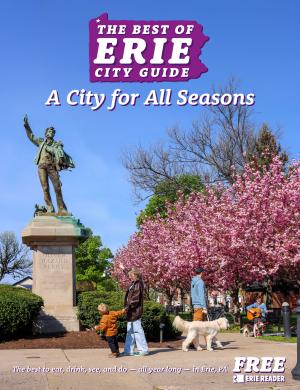
They make mention of the Erie Reader, calling it "a must-read among the progressive-minded population [for] its long-form reporting and opinions," also citing the annual 40 Under 40 issue indexing young business, cultural, and civic figures.
Jim observes the challenges of the K-12 educational system, talking with then-Superintendent Jay Badams about Erie's Public Schools' funding crisis. He weighs that against "the explosion" of postsecondary opportunities, which he writes "has brought youthful drive and intellect to Erie, and with that, a natural spillover of optimistic attitude and culture" adding: "This new Rust Belt phenomenon of positivity and activity is well
Highlighting the "novel and apparently successful way" Erie uses its gambling revenue for "wide-spread civic goals," Jim outlines economic and technical renewal initiatives led by Erie County Gaming Revenue Authority's Perry Wood, such as GO College, Ignite Erie, Tech After Hours, and the Summer Jobs program.
He notes the opportunity afforded to outsiders in Erie, recounting the story of Ferki Ferati, who arrived in Erie in 1999 from Kosovo when his family fled Serbian forces in the late 1990s, landing his family first in Macedonia, then a refugee camp in Fort Dix before Erie. After attending a local Erie high school, two local universities, and completing his doctorate in nearby Pittsburgh, Ferati has since become the president of the Jefferson Educational Society, which Jim notes as "symbolic of Erie's progressive youthful culture."
Deb writes about Erie's inclusiveness towards immigrants, reporting on the work of Dylanna Jackson of the International Institute, Erie's field office for the U.S. Committee for Refugees and Immigrants, and Paul Jericho of the Multicultural Community Resource Center.
In one of the more poignant passages in the book, Deb writes about the Zkrit family, who fled the conflict in Syria after their neighborhood in Aleppo was bombed by Bashar al-Assad's forces. They landed in Erie in 2016, and the patriarch of the family, Muhammad, is looking for any work he can find.
But his optimism in the opportunity of the new life he now has reminds us of what America means not only within our own borders but more broadly.
"We are treated as human beings," he tells Deb through a translator. "America is a dream country."
It's the simple but profound moments like this the Fallows capture that make Our Towns a must-read book of-the-now. They do not project what we could be but acknowledge what we currently are: An already great America filled with people who endeavor to make their hometowns even better.
The Fallows, amidst apparently turbulent and trying times if you watch any amount of CNN, MSNBC, or FOX News, remind us that there's more to America than meets the 24-7 news channel eye and it's splendid, gorgeous, and inspiring — and importantly: the towns and cities here are part of a large chorus of optimistic opportunities being sung countrywide and waiting to be further explored.
Ben Speggen can be contacted at bSpeggen@ErieReader.com, and you can follow him on Twitter @BenSpeggen.
Disclosure: The author is under the employ of the Jefferson Educational Society as its Director of Operations. He is also mentioned in the Acknowledgments of Our Towns.