Stream of Consciousness: Hidden Creeks Links Art, Environmental Awareness
Exhibit explores how 1915 Mill Creek Flood transformed Erie

You could describe the Hidden Creeks Project as a watershed moment.
Indeed, Hidden Creeks underscores why we must all serve as good stewards of Erie County's watersheds and sub-basins.
But the project offers more than a one-time flash of clarity about the environment. Already under way and continuing into next year, Hidden Creeks uses public art installations, an interactive exhibit, and a short documentary, among other resources, to explain how the 1915 Mill Creek Flood changed the face of Erie. In the process, the project offers lessons we can glean from that deadly disaster.
The Erie County Conservation District collaborated with 17 partners, including artists, historians, preservationists, businesses, schools, universities, state, county, and local officials and members of the public, to create and launch Hidden Creeks.
For an introduction to the project, you can start at Gannon University's Center for Lake Erie Education and Research (CLEER), inside Blasco Library. At CLEER, the Hidden Creeks exhibit displays the flood's timeline, traces its path from Glenwood Park to Presque Isle Bay, and shows photos of smashed-up homes and businesses.
At the end of May, the exhibit will move to the Tom Ridge Environmental Center.
Wherever you explore the history of the Mill Creek Flood, you will be taken aback by the historic photos of the damage, including one starkly labeled "Where Ross met death."
He was one of 37 victims.
You might be appalled when you learn that many decades before such tragedies went viral on social media, tourists flocked to Erie by train to gape at the destruction.
You will be startled by the "Flood Sale" newspaper ad for G.L. Pratt at 17th and State streets that blares: "Furniture, Stoves and Rugs must go quick at some price. Cash or credit. We need the cash."
You will be awed by Watersheds, a short film by John C. Lyons, which documents the flood's destruction but also shows how the City of Erie devised the idea to enclose the creek in a massive concrete tube to protect against future flooding.
The Tube is an engineering marvel because of its size – 18-feet high, 22-feet wide, with 2-foot-wide walls – and because of the step-by-step process and manual labor used to construct it underground.
The Tube, though, is also why the 2-mile stretch of water that flows through it has been a "hidden creek" for the last century. When something is buried underground, you could easily forget everything you are supposed to know about how the natural water cycle works, said Kristen Currier, environmental educator for the Erie County Conservation District.
"You can't invent water," she said. "It only makes sense to pay attention to how we treat water, because it's coming back to us. There's an old saying in our industry, kind of tongue-in-cheek, that we all live downstream."
Hidden Creeks is supported by a variety of grants and donations and one purpose is to show that "what goes into our storm drains goes right back into a creek, which flows into a lake or a bigger river or an ocean," Currier said.
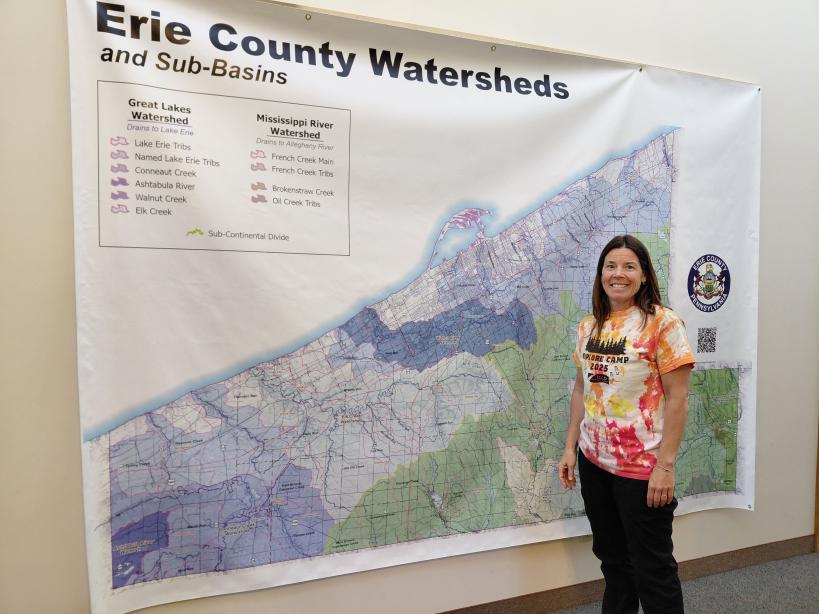
Kristen Currier, environmental educator for the Erie County Conservation District, shows off the giant map that greets visitors to the office at 1927 Wager Road. The map shows which tributaries in our region drain to become part of the Great Lakes Watershed and which ones in southern Erie County, and as well as Venango County become part of the Mississippi River Watershed. It's an impressive visual showing how vital our waterways are to a much larger ecosystem. (Contributed photo)
The Hidden Creeks Project has been developed over the last 2.5 years, Currier said, from an idea that watershed conservation and restoration expert Amber Stilwell (40 Under 40 Class of 2025) came across at a conference. That idea was a public art project in Baltimore done by Bruce Willen, Ghost Rivers: public art installation and neighborhood history walk, according to Currier.
Stilwell, Currier, and others realized that Erie residents are not familiar with the story of the Mill Creek Flood, other than what Erie Zoo visitors learn on the train ride that goes over the creek's culvert at Glenwood Park.
The Aug. 3, 1915, flood was a "traumatic event" that changed how the City of Erie looked, Currier said. On that day, a farmer at the creek's headwaters collected 12 inches of rain in a bucket in about three hours, she said. Chickens, cows, wagons, buckets, timber and trees were all swept along. By 7 p.m., in the area where Erie Veterans Memorial Stadium would later be built, "It was no longer a creek," she explained. "It was a lake. It took out State Street."
Tom Ferraro, Ed Grout, and Steve Mik (40 Under 40 Class of 2024), partners in the Looking Glass Art Project, are helping to tell this dramatic story.
Ferraro and Grout created Looking Glass, which makes public art by engaging with community members, in 2014. Mik joined them in 2020.
The three artists have their own studios in spacious classrooms at the former St. Stanislaus School at East 12th and Wallace streets, but they brainstorm together on art concepts, design and fabrication.
Grout is delighted to be part of Hidden Creeks because of its scope – eight public art pieces, with three confirmed for installation this year and five more planned for 2027 (depending on funding). "It lets the people know what happened in history and what we can do now about not polluting the lake," Grout said.
"Our first installation will be the anchor piece for the project. It is a sculpture made of steel, concrete, granite, and glass and will be installed on the property of Erie Events on the lawn in front of Erie Insurance Arena," Ferraro said. "Conceptually, it will tell the whole story, and we encourage viewers to walk through and interact with the piece."
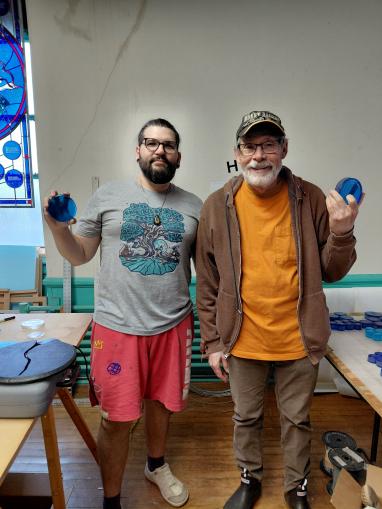 Artists Steve Mik (left) and Ed Grout show off some of the blue glass pieces, uncrackable, that will be incorporated into the public art project for Hidden Creeks."Tom Ferraro is also part of this project. The three men operate Looking Glass Art Project, specializing in public art. (Contributed Photo)
The Erie Insurance Arena art is likely to be unveiled and dedicated about the same time, probably in mid-June, as the mural on the outside of FEED Media Art Center.
Later this year, art students from Collegiate Academy will prepare a mural for part of the wall at Veterans Stadium. Additional art is proposed for next year along the flood's path, concluding with two art pieces in the Bayfront East Side Task Force neighborhood. It will be a "walkable" route, Currier said, although many might prefer driving it.
"Beyond the historical aspect, a central goal of the Hidden Creeks Project is to raise awareness about our environmental impact. We aim to first make people aware of the hidden waterway beneath them and help them understand how their daily choices affect the natural world," said Mik, from Looking Glass. "For example, a study conducted at Behrend found that disposable plastic water bottles were among the most common forms of debris collected from both Mill Creek and Cascade Creek, highlighting how everyday habits can have lasting consequences," Mik added.
Ferraro expanded on Mik's observations. "It is difficult to protect what we cannot see. The city stormwater sewer system connects to the Tube, providing a direct route to Presque Isle Bay, the source of our water supply. Fertilizer, forever chemicals, plastics, and other pollutants wash directly into the system from our city streets. Raising the awareness of how our daily habits impact our water supply is the real story of the Hidden Creeks art project," he said.
Liz Allen can be reached at lizallenerie@gmail.com