Erie's Roasted Boom
How specialty coffee could quickly become your new craft beer
"It's growing and it's changing and it's evolving right before our eyes," Max Marcoline said of the local coffee community. The Erie native, and Director of Sales and Marketing for the Millcreek Coffee Company happily confessed "I've been working with coffee for 20 years, and I literally learn something new every day."
There's a new scene brewing, and it can be compared to: apples, beer, wine, and even guitar strings. This time though, coffee is it's own thing.
The drink itself has been around for centuries. Though legendary accounts also point to much earlier usages of the plant by Ethiopia, cultures on the Arabian Peninsula, primarily Yemen, are credited with developing coffee in its modern form, hence the popular plant species known as Arabica that accounts for more than two thirds of the world's coffee consumption. This spread throughout the Middle East and Africa, eventually becoming popular in America and Europe.
That history and a dime would get you a cup of joe in the early 20th century. It was a ubiquitous feature in dinors (strangely known as "diners" outside of Erie), and workplaces everywhere. Coffee was just what you drank in the morning, the plant's abundance of caffeine providing a much-needed energy boost, whether you were blue collar or white collar.
Then, Starbucks happened. The Seattle-based company reinvented coffee as a luxury item that people were willing to pay more for, in exchange for a better product and experience.
All of this paved the way for the "third wave" of coffee. For these smaller-scale coffee producers, coffee isn't just a drink, it's an art.
These new purveyors take pride in the artisanal quality of their process. They look at sourcing beans with a mind for fair-trade and workers rights. They develop their own roasting methods, and they revel in the bouquet of flavors presented in a deceptively simple cup of black coffee.
This overall movement is far from new in many larger US cities, and Erie is certainly no stranger to progressive, independent coffee shops — just ask anyone who remembers going to places like Cup-a-ccino's (In fact, that very same storefront, now the Mediterranean cafe Alkeme, has some fantastic coffee creations of their own).
The trend has been on a slow simmer, and just like a coffee roast, the heat is gradually rising.
"For specialty roasters like us, and others like us, we've noticed our business is growing because people are becoming more intrinsically discriminating when it comes to what they want," Marcoline reasoned.
"This in turn leads to smaller coffee operations picking up the business subsequently. They're the next logical step, when drinkers think 'okay, now I'm going to be really particular about what I like,' or really open-minded, depending on how you look at it." The customers gain a level of ownership and pride in their personal preferences. Larger companies, by nature, are mostly limited to a handful of different blends, while some specialty roasters will have dozens of varieties to choose from.
One simple thing that businesses like Starbucks started doing was simply telling customers where their coffee came from. Even your casual enthusiast will give a nod of acknowledgment to blends from Columbia, Kenya, Guatemala, or Sumatra.
Matt Shay, founder of Happy Mug Coffee, underscored the importance of the source, known as the "origin," explaining that "basically every origin has unique characteristics that aren't going to be found in other origins. Like in a beer, you have all these kind of different hops, and people kind of understand that, but they might not understand that a blend of this origin and that origin will taste a certain way." Of course, not all coffee from a given country is created equal. Shay was quick to note that "every country that grows coffee tends to grow a certain set of varietals. If you think of coffee beans as apples, for example, there are all kinds of apples — McIntosh, Granny Smith, et cetera — very different. So in any country, they have certain varietals that do well." He added that "they also have different processing techniques which affect the final taste."
Marcoline echoed a similar statement positing that "say you had a Sumatran coffee you were a fan of. Well, Sumatra, for example makes a great many different kinds of coffee and not all of them are your favorite coffee, nor are you aware of all of these different coffees that Sumatra makes." No country has a monolithic taste. Couple that with the fact batches vary from year to year, even from that same plantation and, as Marcoline exclaimed "you've got these really deep, interesting circumstances that so many people partake of and many of them don't know anything about it."
For those that seek a 100 percent locally-made loop, the unfortunate fact is that by design, coffee needs to be imported. Marcoline explained that coffee "can't be grown locally, so it has to be produced locally in other ways, because it has to come countries along the Equator," also noting that there is a small amount of coffee being grown in southern California. At this point, though that product is still far from the level of its South American or African competitors.
Shay boasted that "we're able to showcase origins of coffee that you don't often hear about." Citing the appearances of rarer varieties Shay notes that they feature selections "from Burundi, Africa, from Malawi, Africa, from Bolivia, these places that people don't even think about when it comes to coffee."
Though the origin is an extremely important piece of a coffee's flavor profile, it's just the beginning. "The growers, the actual people that farm the land, these are often family operations — and keep in mind that we're almost exclusively talking about third world countries here — for them, coffee has to be picked by hand so it takes a large labor force," Marcoline explained. To get a better grasp at the work involved simply by getting the beans, he broke down the numbers, weighing that "in general the number it takes to create a pound of roasted beans is about 4,000 coffee beans. So keep in mind that each coffee cherry is picked by hand and has two coffee beans in it. That's what's interesting, the massive scope that it takes to create this thing that we in this country just completely take for granted."
From there, it's about getting the fruit of the cherries off of the coffee beans. Then the beans have to be dried before they can be bagged and shipped out, where they can keep for a much longer time, years in fact.
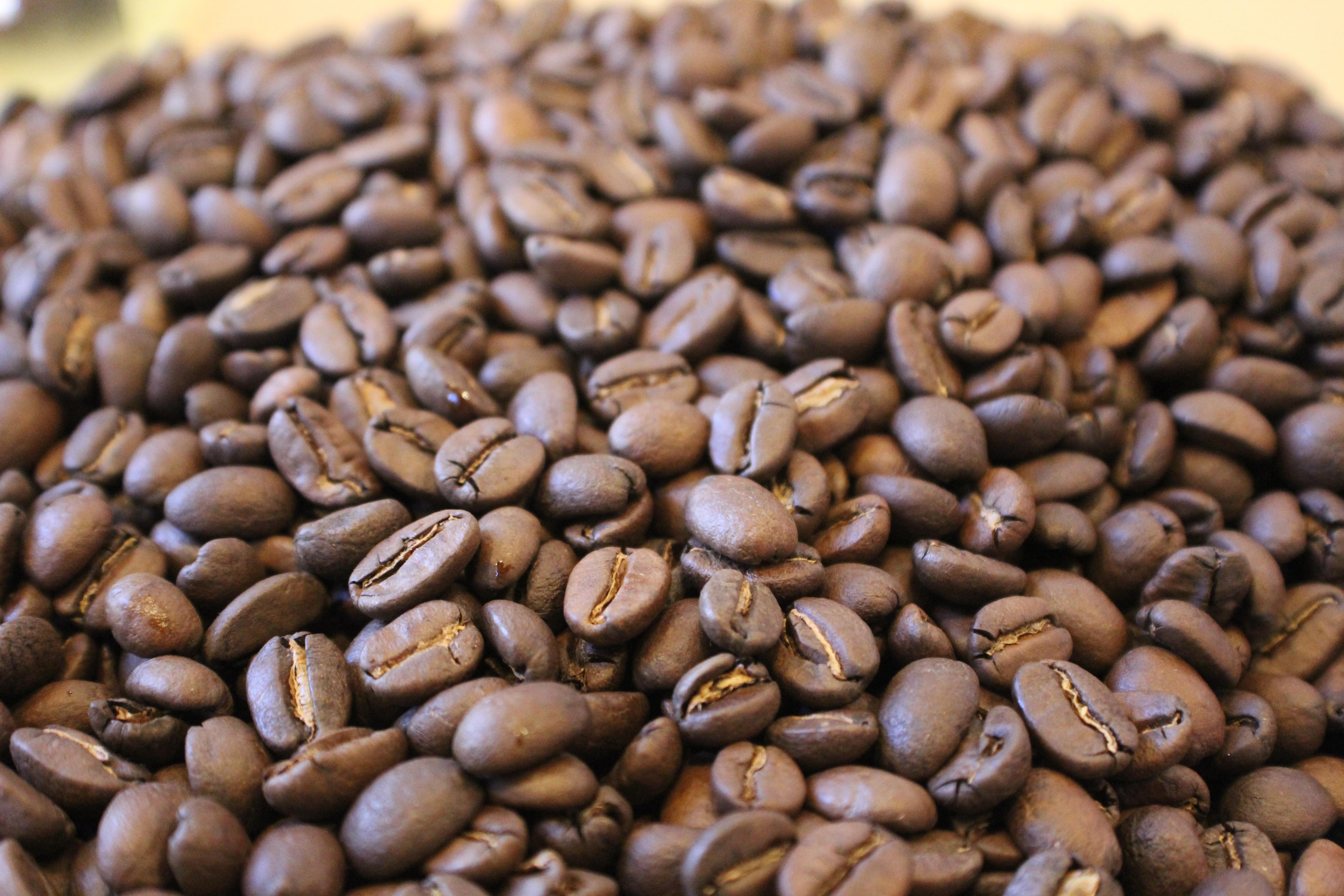
At this stage in the game, these dried beans are known as "greens." One look, and it's easy to tell why. This is before the roasting process, where they look more like shelled pistachio nuts rather than the shiny brown beans that most people picture when they think of coffee.
As greens age, they can lose some of the subtleties that distinguish themselves from other beans. A Sumatran bean, for example, may lose some of those unique characteristics that originally made you a fan. After they're roasted, however, it still tastes like, well ... coffee. It's by roasting these older, underwhelming beans for mass consumption that large-scale coffee producers make their money.
The new breed of specialty roaster isn't looking for those kind of beans. Like a discerning chef, they know that the best ingredients get them the best results.
Michael Reed, co-owner of Meadville's Tarot Bean Roasting Company shared an analogy that I, as a musician, immediately identified with. One day a customer struck up a conversation with him in the store. The customer compared coffee beans to guitar strings, and the metaphor stuck with him. We were both able to identify our preferences without hesitation (he likes the company Ernie Ball while I prefer D'Addario). For various reasons, the ever-so-slight differences are evident to us, whether it's their tactile feeling or their audible results. To a layman, they're all basically thin wires with a cylinder attached, but like with any passion, the tools of the trade definitely matter.
It's during the actual roasting process that each batch of beans acquires their particular taste palette. Essentially the cooking of the beans, heat is applied to greens at a steadily increasing temperature for about 15 minutes, depending on the machinery. Less time and lower temperatures yield a lighter roast, while a darker one gets more heat for a longer span. From this simple window, roasters can dramatically vary what you end up tasting.
Nick Attalla, Vice President of Erie's Premium Coffee offered his personal opinion, saying that "I like a nice full-bodied cup of coffee, but then again there are light roasts that are sweet mellow, and smooth. Everybody has their own taste."
The most recent Erie's Best Coffee event showed that Attalla and his associates may be on to something. Winning awards for the Best Flavored Coffee, Judges Choice and the People's Choice, Premium Coffee was named Erie's Best Coffee. "The community has welcomed us with open arms," Nick Attalla expressed. "They've been so nice. I like to just bring a good cup of coffee to the community that's not seven dollars a cup, you know?" he said with a laugh.
Finding the perfect roast is elusive and captivating. Reed reasoned that "we do small batch roasting, and the whole idea behind small batch roasting is more control. We can finely tune what our roasts are, where we're at, much like craft beer or wine, there's tasting notes, there are things that are hidden that different roasts bring out."
Having previously tried his hand at winemaking, Reed concluded that "I like coffee roasting more, because I like instant gratification, with wine and beer you've got to wait and then taste it and then go back and try again, saying 'well we've got a couple months to wait' whereas with coffee you can taste it, and if it's not quite there you can tinker with it, you can start it over, and 20 minutes later you're ready to go."
The comparisons to craft beer keep coming, a movement which from its start drew comparisons to wine tasting. It's no shock that there are a few people in town seeking to bring all of those imbibable interests together, like Gisele Littrell, who will soon be opening up the Tipsy Bean in the Independence Hill district. "It's been a long time dream. I'm just passionate about coffee and alcohol, so I'm combining those two passions together under one roof," she said, chuckling. She described an "all day coffee shop with wine and beer, which will be open late nights, with music, poetry readings and more." Littrell, owner of French Maids LLC, says they're "also planning a delivery service and a charcuterie, sourced all from local roasters. There's so many great roasters now locally."
If it's before 5 p.m., Nick Warren is probably drinking coffee at this very moment, black as midnight on a moonless night. He can be reached at nick@eriereader.com