Erie's Zine Scene: Past and Present
Why DIY self-publishing in real life has been, and always will be, a thing

You never know what will become a formative moment.
Picture this: it's 1996 and I took an EMTA bus to the Millcreek Mall with my friend to walk around, exist outside of our houses and parents, and try to figure out what it means to be a semi-adult human being in the world. I wandered into the Record Den (one of multiple record stores in the mall at the time) and picked up a free copy of a newsprint zine called R.T.R. (i.e., Road to Ruin) from a stack piled on the floor and started to flip through it. I was rapt. It was crammed full of interviews with local punk and hardcore bands, show previews and schedules, multiple sections of dense script from contributing music writers, album reviews, and local ads showcasing the Erie music scene at the time. I was instantly hooked on the idea of free local newsprint, and I guess I never let it go.
R.T.R. was a DIY zine (which is basically a limited-run, self-published booklet or magazine made for personal interest or expression, not profit) conceived by, edited, published, and largely written by local historian, author, musician, archivist, and mega-music-fan Debbi Lyon through her production company Lyon Tamer Press. At the time of the zine's conception and production, Debbi was working at Record Country, an independent record store in Wesleyville in operation from 1978 to 2004, which facilitated many of her connections to the local music scene.
This paper was largely made before the internet was a major part of our daily lives and the layout has a columnar, cut-and-paste look to it that gives away its age and its DIY ethos. "I did a couple of issues of So-So-Ciety with Art Fridrich (a local punk and underground zine published in the Wesleyville area during the mid '90s) before he moved to Chicago. And we brainstormed that zine while sitting on the floor of John Vanco's place on Parade Street," Lyon recalls. "Then, in September of 1996, I started R.T.R. with $500 that I had saved. I published nine issues in the first year with a lot of help from the metal, punk, and hardcore communities in northwest Pennsylvania."
Print media runs through Lyon's veins and creating R.T.R. was a logical outcome of her life up to that point, "I was a fan of Trouser Press, Bomp, the Cleveland Scene, and the Chicago Reader. I was the editor of my middle and high school newspapers. I wrote freelance for the Erie Star, the Erie Times-News and Showcase, Billboard, Guitar Player, Foundations, and other industry and local music publications. I was in the habit of writing, listening to music, and playing guitar every day." She continues, "People would call and tell me about upcoming projects and invite me to shows. It was all about connecting in real life and making memories."
Additionally, while working at the record store, she made connections with record labels (like Victory, Revelation, Epitaph, Roadrunner, Century Media, etc.) who were eager to buy ads, which provided just enough income to get the zine printed and distributed.
Cover art for R.T.R. ranged from show-flyer type graphics to contributed custom illustrations from local artists like Pat Mazzone, Jim Turowski, Tim Markin, Nate Gillies, Mike VanWinkle, Travis Sheldon, and Mark Welser. Regular contributors included, among many others, Mike Ski, Jon Miller, Melissa Hinman, Dan Rapela, Leslie Greenman, Dave Steele, Lynn Cummings, Ben Frazier, Doug Corey, and Devin Young.
R.T.R. went through a run of 15 papers before other local history interests called away Lyon's authorial attention (she published Greetings from Wesleyville, "a 484-page tome" in 2007, a second Wesleyville book in 2010, in addition to creating a blog called Old Time Erie). "I wish I had time to publish another issue of R.T.R.," Lyon shared. "Reading physical media is intentional, as opposed to doomscrolling."
From that day in 1996 forward, I picked up an R.T.R. every time I saw one. This zine introduced me to new bands, it informed me about all-ages shows and venues (I am eternally grateful to have learned about somewhere to go that wasn't the mall), it provided a sense of community to a flailing adolescent looking for somewhere to belong, and it filled me with a sense of admiration for the deeply cool person who took the time to make this thing over and over again.
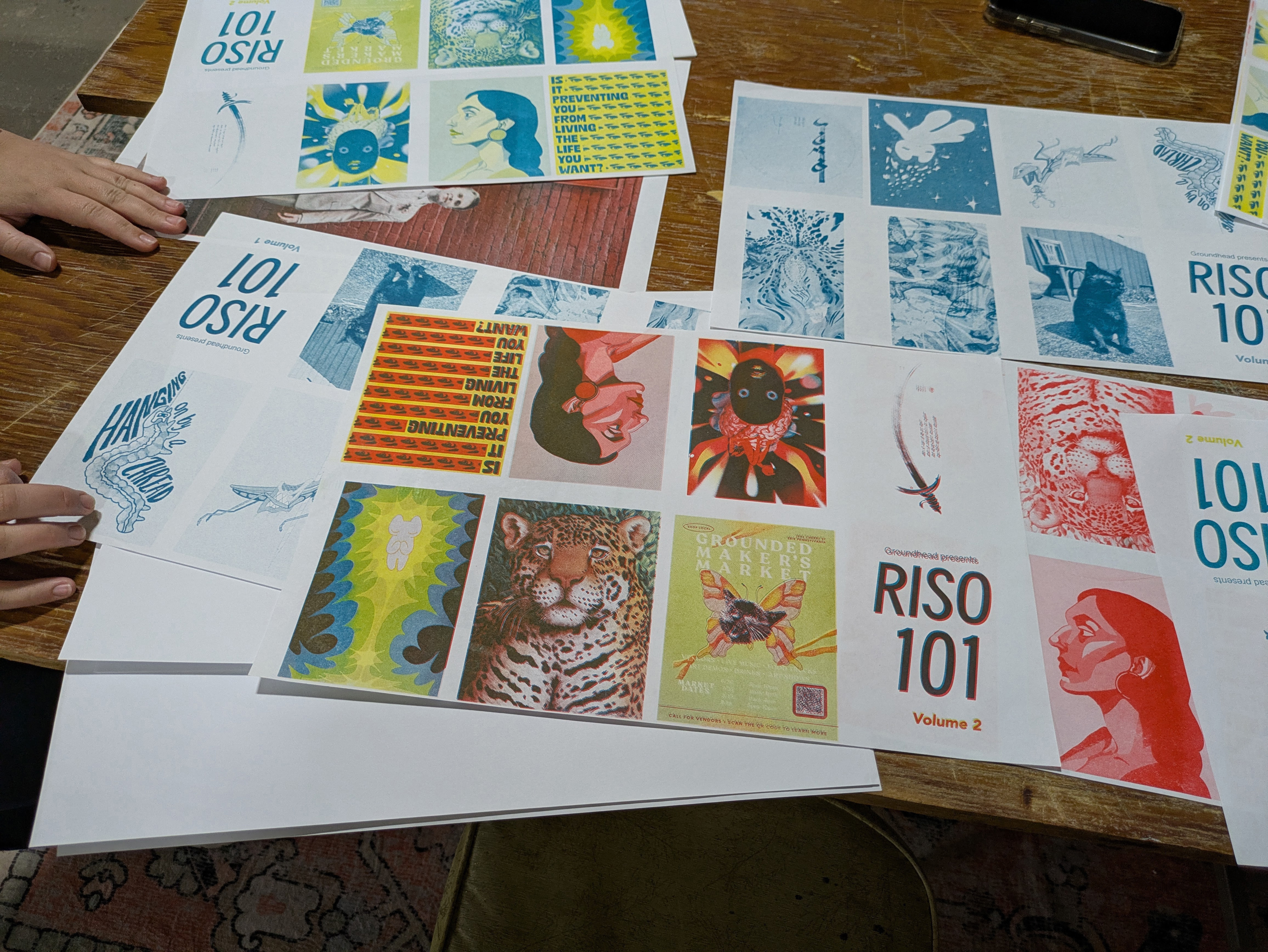
Local art space Grounded Print and Paper Shop hosts monthly classes teaching attendees how to use the Risograph printer (basically a screen printer inside of a copy machine) to make a collaborative art zine. (Photo: Erin Phillilps)
Fast forward 30 years from that day at the Millcreek Mall, and we find ourselves in an (often exhausting) digitized world – where the knee-jerk course of action to promote a record, show, event, or business, or to share our thoughts or creations, is to post about it on social media.
But just because that's the obvious way doesn't mean it's the only way.
There is something happening in Erie right now – call it a zine resurgence – but finding independently printed and published zines (or learning how to make your own) is not as niche as you might think.
Local artist and owner of Grounded Print and Paper Shop Ashley Pastore (40 Under 40 Class of 2022) is on the front lines of local zine production – in her art space that encourages collaboration and physical production of paper and prints, houses a Risograph printer available for public use and multiple tenant studio artists who make zine and zine-adjacent products and teach zine-making classes.
At Grounded, a group of folks including PennWest Edinboro and Allegheny College art professor Doug Eberhardt, teaching artist, illustrator, and graphic designer Alex Strasser, and screenprinter and owner of Leadhead Screenprinting Chris Pace, is all, in one way or another, currently making zines and feels passionately about the artform as a form of self-expression.
In his class at PennWest Edinboro, Eberhardt and his students create a collaborative themed zine every semester – the most recent being the students' interpretation of the theme Teeth. With artwork ranging from prints to digital arts, poetry to painting – all of the images are eventually run through a Risograph printer for a final product that looks uniform despite its disparate media.
Eberhardt explains why having the physical zine at the end of a class is important: "I think a lot of college students are into seeing their work come into a physical space. Digital drawing is so popular – they all have iPads and are constantly on screens, creating, or sharing things with each other. But once they see their images coming into physical reality – through zines, Risograph printing, screenprinting, all print-made things in general – they're really excited and surprised at how satisfying it is."
Strasser and Pace give me a rundown of how their monthly zine-making class works in tandem with the Risograph printer at Grounded. The RISO brand printer was created in Japan in 1986, and it uses similar technology as silk-screenprinting – using soy-based ink (three colors are available in the Risograph at Grounded) in a newsprint-type fashion. You can either place a physical image or object on the scanning bed (like a photocopy) or you can load it in through a computer program. Pace explains, "The machine uses a heat needle and it etches the image onto a thin rice paper screen that is draped over a drum. Then, when the drum spins inside the machine, it forces the ink out through the paper screen. It's kind of like screenprinting mixed with a Xerox machine."
"The Risograph printer is so awesome – it's a really efficient way to make colorful, beautiful zines. Before having access to the RISO printer, I made a lot of photocopied zines or outsourced them to a printer, but the machine is just so beautiful and it makes more of an elevated zine. It feels more like an art book," Eberhardt explains. "I was initially intimidated by the Risograph printer and maybe that's what is stopping some people from collaborating and doing this cool thing – so I would say if anybody is curious, it's not as hard to use as I thought and I think they should definitely take a class, try it, and I'll bet they'll really enjoy it."
Grounded Print Shop offers a monthly "Intro to Risograph" class led by Strasser in which attendees create a unique, collaborative Risograph-produced foldable zine featuring their own art or photographs. The next one is scheduled for Monday, Sept. 28 at 5:30 p.m. or folks can stop by Grounded Print Shop (located at 1902 Cherry St.) for their upcoming Makers Market corresponding with Gallery Night on Friday, Sept. 18 from 5 to 10 p.m. to check out the Risograph printer, see some examples of zines made that way, or sign up for a class.
A more philosophical thought that arose during our conversation at Grounded Print Shop was the question of why someone would want to make a zine today – Pastore mused, "It is interesting to think about what the purpose of a zine used to be – like a way of sharing alternative information before you could just Google it. And so what is the appeal now, outside of the aesthetics of it? What's the real reason to make a zine?"
Those in attendance offered some theories. Eberhardt thought, "Zines were initially used as a tool to self-publish, to put your ideas into the world and share them. The thing that's shared with that idea today, regardless of the content, is that there's something gratifying about putting your stuff into a physical space."
Strasser concurs, "It feels more important once it's printed out – if it's a book, you now have it and you know where you put it or you can give it to somebody else and there's a better chance of them actually seeing it. You gave them the actual thing – it's more limited but more impactful. It feels lucky, like you found a treasure."
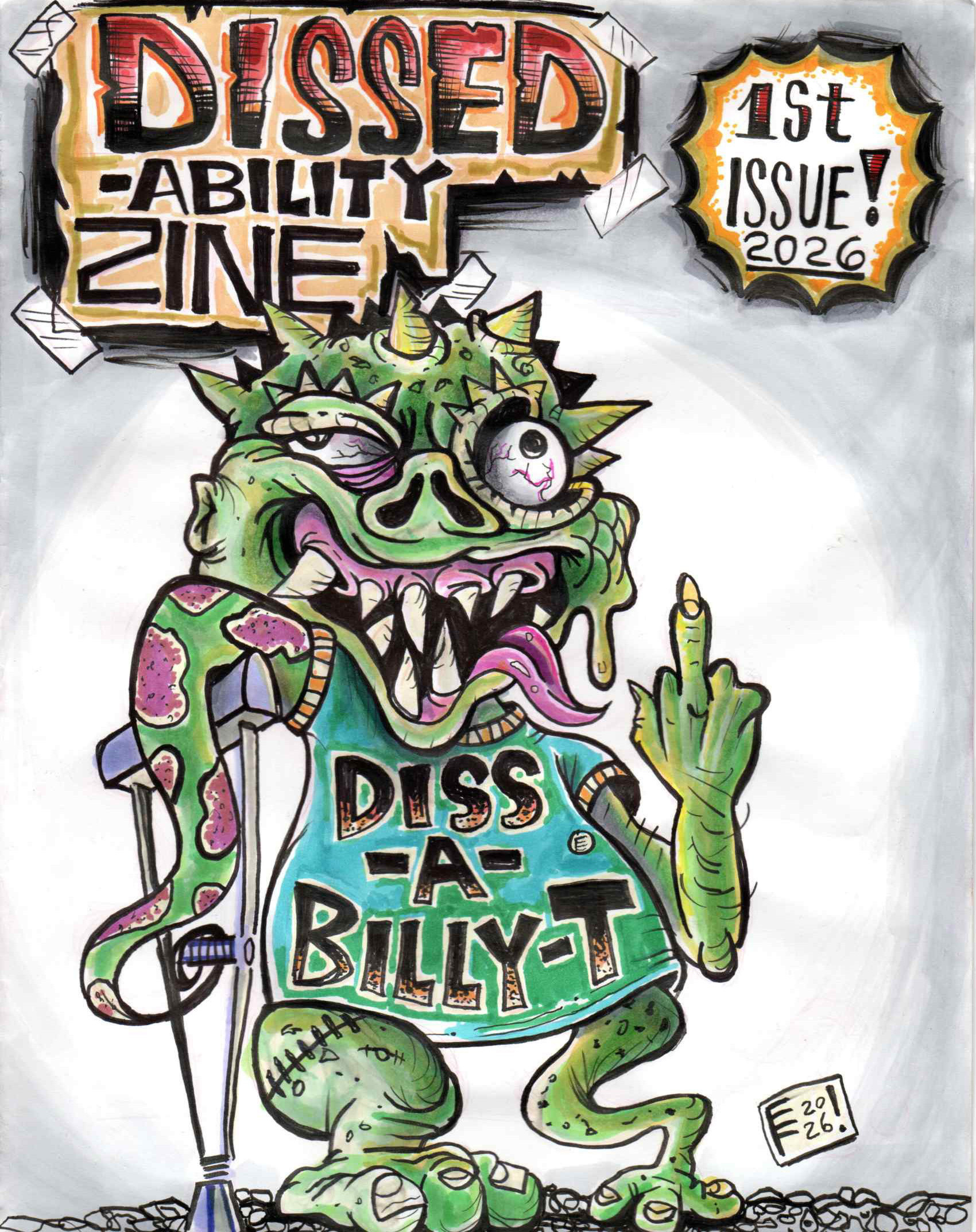
The first issue of Erie's latest zine, a brainchild of Bob Jensen, DISSED ABILITY, will be available mid-September. The zine grew from Jensen's increasing frustration with America's health care system and helps to lift the voices of those with disabilities in our community.
To get another answer to Pastore's question, I asked someone who is actively making a print zine today. Enter Bob Jensen, 40 Under 40 alum, former owner of Basement Transmissions, artist, musician, and all-around Renaissance man – who also happens to use a wheelchair – as he embarks on self-publishing a zine entitled DISSED ABILITY. For Jensen, making a zine felt like a way to use his art and his voice to say something that he felt needed to be said. "I decided to make a physical zine for several reasons, all of which begin with my disability." After working with others with disabilities at Voices for Independence for two years and witnessing their struggles, followed by a harrowing year of emotional decisions and losses, including aiding his father through his cancer diagnosis, treatment, and eventual passing, and then dealing with his own chronic pain and neuropathy, Jensen says, "I have come to realize the health care system is completely broken and that's when I started drawing comics that focus on disabilities issues." After being shuffled around from office to office, waiting months for appointments, "hours upon hours of my life gone to Muzak and on-hold robots with no accountability," he said he connected with others on social media who were experiencing similar frustrations with the health care industry. "I said: that's it. I'm going to make a zine to get people working together for change. I always loved seeing DIY zines because they just seemed to explode with creativity and ideas."
The first issue of DISSED ABILITY is slated for a Sept. 15 publication date and will include contributions from local writers and artists who all come to the project with their own experiences with disability. Included in the first issue will be: an article contributed by Noah Britton, who is best known as the subject of the 2016 Netflix documentary Asperger's Are Us, comics and graphics from Erie-based artist Eerie Eric Fargiorgio, an article titled "Throw Out the Line" about the seen and unseen aspects of disability contributed by Aaron Davis, a column from Kathryn Hicks called "Fashion Talk" which gives insight into shopping with unique body sizes and needs, poetry from the mother of autistic children, with more content in the pipeline.
Jensen adds, "It is a free zine to anyone with a disability and I am asking for a $3 donation from anyone who may have the funds. I plan on handing them out at local events, as well as hand-delivering them to politicians locally, and eventually going to D.C. to do the same."
DID YOU KNOW? The Erie County Library's Idea Lab at Blasco library is hosting a free "Make a Zine" class on Wednesday, Sept. 30 from 6 to 7 p.m. for folks ages 11 and up. They will provide all necessary supplies and have some examples to get your creativity flowing. This is a great way to get started in the hobby. No registration is necessary. Visit events.erielibrary.org for more info.
While Jensen uses the artform of a zine to attempt to make social change and to give those with disabilities a platform, others like Eberhardt and his wife Lauren Lowry have made zines for years as their own personal artistic experiments. "My wife and I have been making zines under the name Jet Black Press since around 2010. We always liked zines – she's a librarian and I'm a printmaker, so zines were where a lot of our ideas could come together."
For Debbi Lyon back in the '90s it was all about bolstering the local music scene, connecting with people, and creating – often simply for the eventual memory of it all.
Paging through all those old R.T.R.s in preparation for this article was an incredible walk through a time and place that, if you were there, you would never forget anyways. Lyon just made sure of that.
R.T.R. wasn't just a slice of life from Erie's bygone music scene, it stands as a moment from a time when the slower form of print media was a primary way people shared their ideas and information. With articles like one penned by Ben Frazier listing the (hilariously scant) amount of indie music and record label websites that existed in 1997 or a zine review section where Lyon herself listed and reviewed the multitudes of zines that were regularly in circulation at the time (like Chumpire out of Conneaut Lake, Foe out of Bethlehem, War Paint penned by Erie's own Mike Ski, or True School created by Digression's Bill Gehrlein), these publications recall a time when we were much more intentional with what we read and how we spent our time.
Lyon shared with me that she still has the layout for an unreleased R.T.R. issue in her archives. Anyone want to kick in a few bucks to help that treasure trove of '90s Erie nostalgia see the light of day, maybe printed on a Risograph this time around?
Erin Phillips is very grateful to have a pack-rat of a husband who saved all but three issues of R.T.R. to help inform this article. She's missing issues 4, 7, and 9 if anyone wants to help complete the set. She can be reached at erin@eriereader.com