The Bones Beneath Our Feet
The history of Erie's lost cemeteries and what happened to them

"It is a sad, but not at all times unpleasing duty to dwell in thought upon the City of the Dead." This is the opening line of the book Erie Cemetery: A Handbook, published in 1903.
As a lover of history, I often find myself, not unpleasingly, dwelling upon thoughts of the dead. Lovers of history in general, myself included, are also likely lovers of cemeteries. My personal love of exploring cemeteries is well-documented within the pages of this publication, particularly in the October issues (as I've covered the Erie Cemetery, the pet cemetery, Axe Murder Hollow, and the Weis Library cemetery, etc.). Local historian and scholar Mark Steg is also pretty passionate about historic cemeteries.
Steg has done extensive research into what are generally referred to as "lost cemeteries" in Erie. He initially became interested in researching them when, after graduating from Gannon with a degree in history, he spent some time in Germany with the ROTC. "It started dawning on me that these out-of-the-way places where tourists would have never gone are loaded with all of this incredible stuff: a Roman road or a castle in the woods. Then it clicked – maybe Erie has places like that. And it does." He explained, "I like cemeteries because they're real, tangible – probably the most tangible next to architecture – remnants of the historical past."
When one thinks of burial grounds in Erie, one often thinks of the historic Erie Cemetery, Wintergreen Gorge, Lakeside, or Trinity, or one of the long-standing Jewish cemeteries – but throughout Erie's history, burial grounds varied from long-forgotten well-established cemeteries to meager plots in people's backyards, and in the case of a large portion of human history, wherever someone happened to die.
I first started thinking about unknown or "forgotten" cemeteries when I arranged a historic biking tour of the West Bayfront for the Erie County Public Library's HistErie week (in partnership with Our West Bayfront and Preservation Erie). The home I was researching was one recently acquired by Our West Bayfront on Myrtle between Seventh and Eighth streets. It is a very old house, built in 1832, and in looking at a map of the City of Erie from 1851, I noticed that it was one of the only buildings on the block at that time and that the area behind it to the west was labeled as "cemetery," with the Erie Extension Canal flowing directly behind it.
This cemetery was mentioned, along with scads of other long-forgotten grounds, in an article written by Steg for the Erie Times-News back in the mid-1990s that was never published. Within this typewritten article, Steg catalogs a number of former burial sites in Erie, along with the one at Myrtle and Seventh streets, which was an Episcopalian site established around 1827. The remains that once reposed within what is now a bustling neighborhood were likely moved as development of the area began – most likely, according to Steg, to a plot near the Erie Insurance Arena (formerly the Louis J. Tullio Arena and the Erie Civic Center) before being moved again, and finally, to the Erie Cemetery.
That Civic Center Cemetery was one of the first community burial grounds established in Erie in 1805, spanning three lots around the southeast corner of Eighth and French streets. When the property was sold in 1862, the bodies were removed for re-interment at the Erie Cemetery. Local lore persists that there are still remains within the ground at this site. In that aforementioned unpublished article, Steg wrote, "All the bodies were supposedly removed to other locations. In actuality, they were not, and during the Civic Center construction in 1981, the remains of at least 14 individuals were found."
This is not at all uncommon. While this cemetery at the Civic Center site was well-documented, many other "forgotten" cemeteries are hiding in plain sight all throughout Erie. It is generally legal in Pennsylvania, with state permits and abiding local zoning laws, to bury human remains on private, church, or family property and the documentation, maintenance, and general respect for these grounds varies wildly depending on where one looks.
If we look way back to the Indigenous burial grounds that existed in the Erie area in the past, we can find that, to early white settlers, these areas were sacred only insofar as they were potential farmland. In an area once referred to as Warfeltown, named for the Martin Warfel family who once lived on the homestead around present-day East Avenue and Elm Street, roughly from East 18th to East 28th streets, there existed a known Native American burial ground just east of East Avenue. According to newspaper reports at the time, "This burial ground of the Eriez Indians became a popular site for schoolchildren and other researchers to search for skulls and other human remains." According to Bates' History of Erie County, "Directly south from the Martin Warfel place, and in the southeast corner of the city limits, was an Indian graveyard, where the boys of forty years ago (Bates' book was published in 1884) used to irreverently dig into the mounds and gather bones as relics." He continues, "The first field east of the burial ground was cleared in 1821, and for some years after it was a frequent thing to find stone hatchets and other rude implements of the aborigines. It was the custom for many years after the incoming of the whites, for parties of Indians to camp nearby and indulge in peculiar rites in commemoration of their ancestors … the mounds have all been plowed down, and no traces exist of this once sacred spot to the red men." (sic, 1884 text)
And while some may think that respect for these sorts of heritage sites has matured with time, the area in which I met with Steg suggests that development will nearly always win out over preservation, or for the archaeological, educational, spiritual, and cultural value of the artifacts that wind up lost to time.
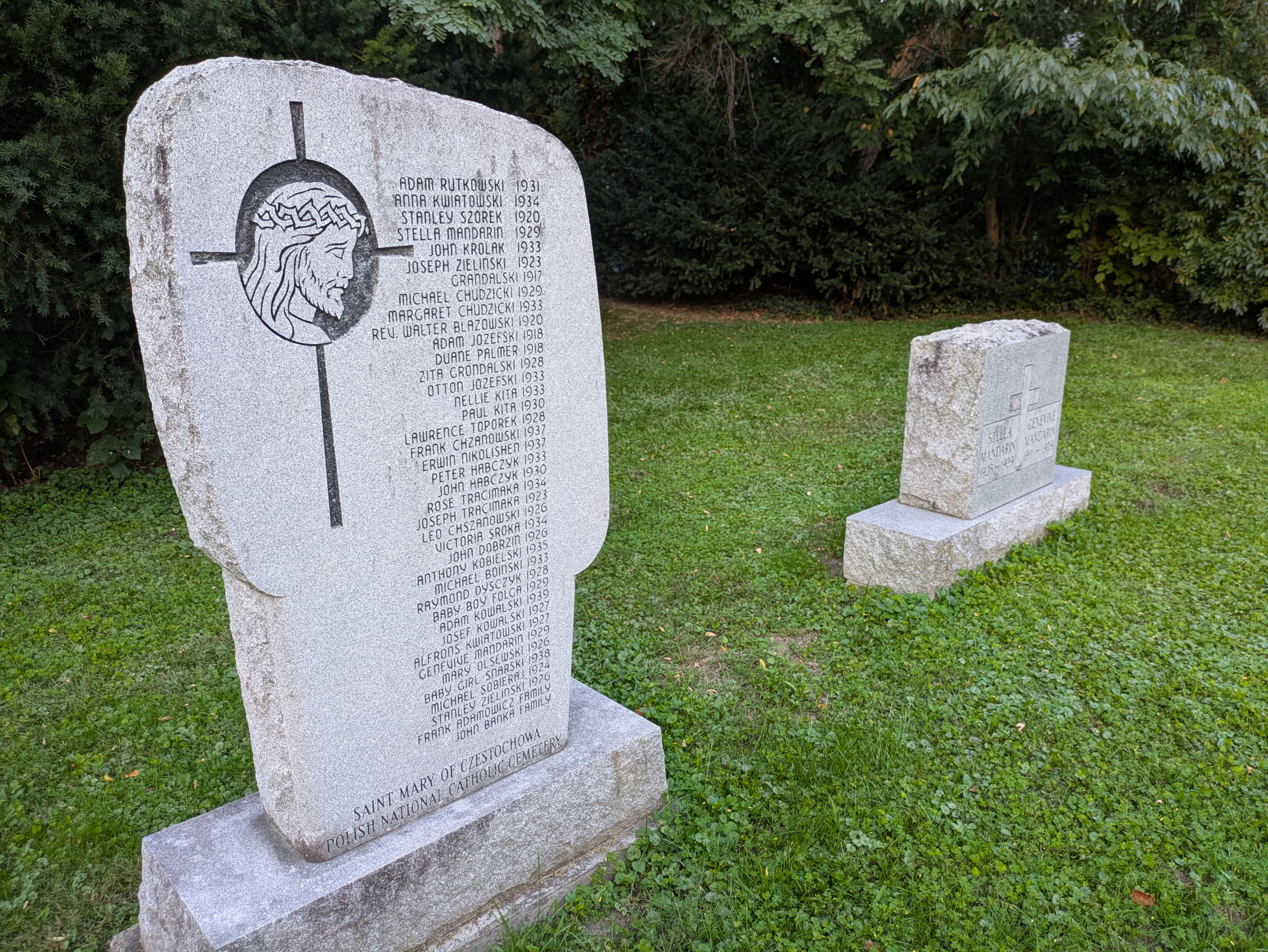
In 2001, the site of the St. Mary of Czestochowa Cemetery on Merline Avenue was rededicated to memorialize the folks buried within with a pair of stones pictured here. (Photo: Erin Phillips)
Steg and I met up at one of the "forgotten" cemeteries he wrote about, in the parking lot behind St. John's Lutheran Church and home on West 23rd and Sassafras streets. Before there was a building here, there was a cemetery. In an Erie Daily Times article from 1933, it was dubbed "One of the Smallest Cemeteries in the World." Steg recalls, "I remember what it looked like – there were big slab gravestones written in German from the 1830s and 40s. The home here wanted to expand and, in Erie, expansion means parking lots. So they put a parking lot over this really unique thing. They took the stones and interred them in a crypt and put up this monument. But the people are still buried here, right under the parking lot."
That news article from the 1930s noted that there were "24 graves, nestled in a residential section at the yard of the Lutheran Home for the Aged, compris(ing) probably the most unique cemetery in the world and is destined to be maintained forever. The site, on which the home is now located, was given with the understanding that the land be used as a burial place. A court order several years ago held that if a portion of the property were maintained as a graveyard, conditions of the deed would be fulfilled. Hence the tiny cemetery."
While it is true that anyone can still visit this tiny area set in the northeastern corner of the parking lot – it has not truly been maintained as a graveyard, at least not a historic one in the sense that the gravestones and site were preserved to view. There is a bench and a memorial stone with the names of the folks buried there, right beneath your parked car.
Another "forgotten" cemetery hidden in plain sight in Erie is on Merline Avenue in a totally residential area. This spot was, at one time, wooded and mysterious with low-lying gravestones, dilapidated crosses, and a low fog. Steg has formative memories of this spot: "When I was a kid in the mid-'60s, I grew up in Glenwood, and this one kid who was known to stretch the truth told us there was a cemetery in the woods. We were about 10 or 11. I'll never forget it – it was all overgrown at the time, there was a path and I rounded a bend, and I see this cross sitting at an angle, another big wooden cross on the ground, and this ground fog – I must've jumped in the air, spun around, and ran out of there."
This plot is known as the St. Mary of Czestochowa Cemetery, or the Polish National Cemetery. However, the church dissolved around 1939 and the cemetery fell into disrepair (as evidenced by the experiences of Steg). Steg reported in that unpublished article from the '90s, "Eventually … the city cut down the woods covering it, removed the mostly fragmented stones, and graded and reseeded it. It now looks like a lawn, but the bodies are still there." Then in 2001, the site was re-dedicated with an engraved memorial stone listing 34 names of deceased, although some records indicate that up to 80 burials took place at the site.
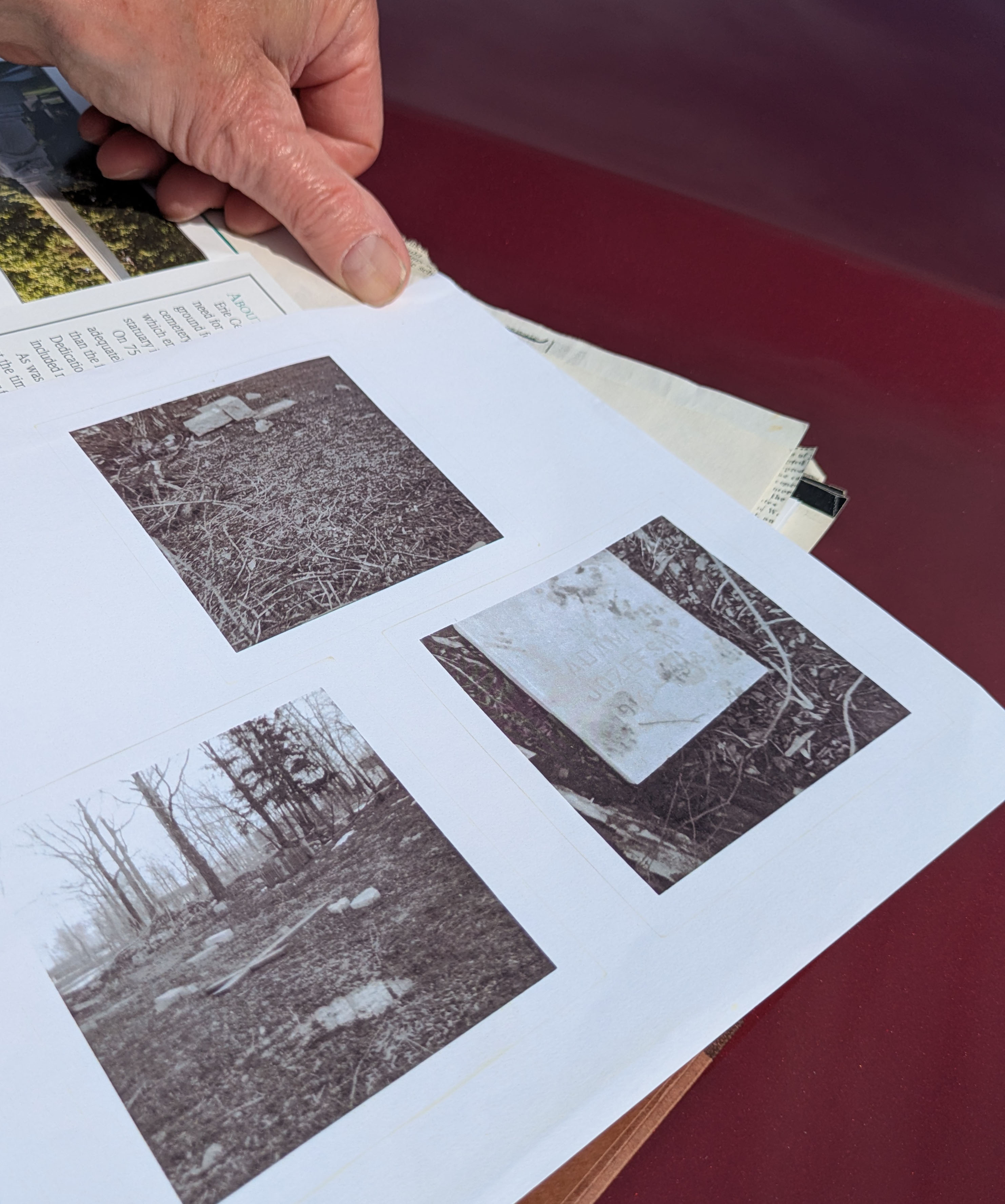
Steg shared a file folder of information on lost local cemeteries – including some of the only known photographs of the St. Mary of Czestochowa Cemetery on Merline Avenue before it was cleared out, mowed over, and largely forgotten. (photo: Erin Phillips)
During our time at the site of one of the smallest cemeteries in the world, Steg pulled out a manila folder full of photocopied news stories, brochures from local cemeteries, and handwritten notes that list dozens of potential "forgotten" cemeteries, including examples from extremely early French graves, the foot of Parade being rife with human remains from various battles as well as being the site of an early hospital. He shared stories of soldiers who were executed for desertion and buried on Presque Isle (with skeletal evidence eventually surfacing in a storm), the infamous Rutledge grave purportedly still underground at 14th and Turnpike (near Union Station), the site of the former Harborcreek post office that was built directly on top of one of the oldest cemeteries in that area, the pauper's cemetery that was discovered during construction of Amsco around 21st and Pittsburgh and was relocated to Fairview, the cathedral crypt inside St. Peter's which houses the remains of a number of bishops, and so on.
Additionally, in searching for some local information on private graveyards throughout Erie County, I came upon a document published by the Erie Society for Genealogical Research, compiled by Dick Tefft, and published in 2005 that meticulously lists nearly every known site of a burial in Erie County. It is remarkable, as it contains well-maintained municipal cemeteries alongside notes about long-forgotten small family grave sites like the "Freeport Burial Ground" in North East, along with instructions to take Route 5 north onto Freeport 0.2 miles and take a left on Freeport Lane to a dead end. "The cemetery is in the woods about 50 yards and is only three stones." The book contains maps and GPS coordinates to each site. The research is astounding in its content as well as its abundance – it is a real possibility that the dead lie beneath our feet at any given location.
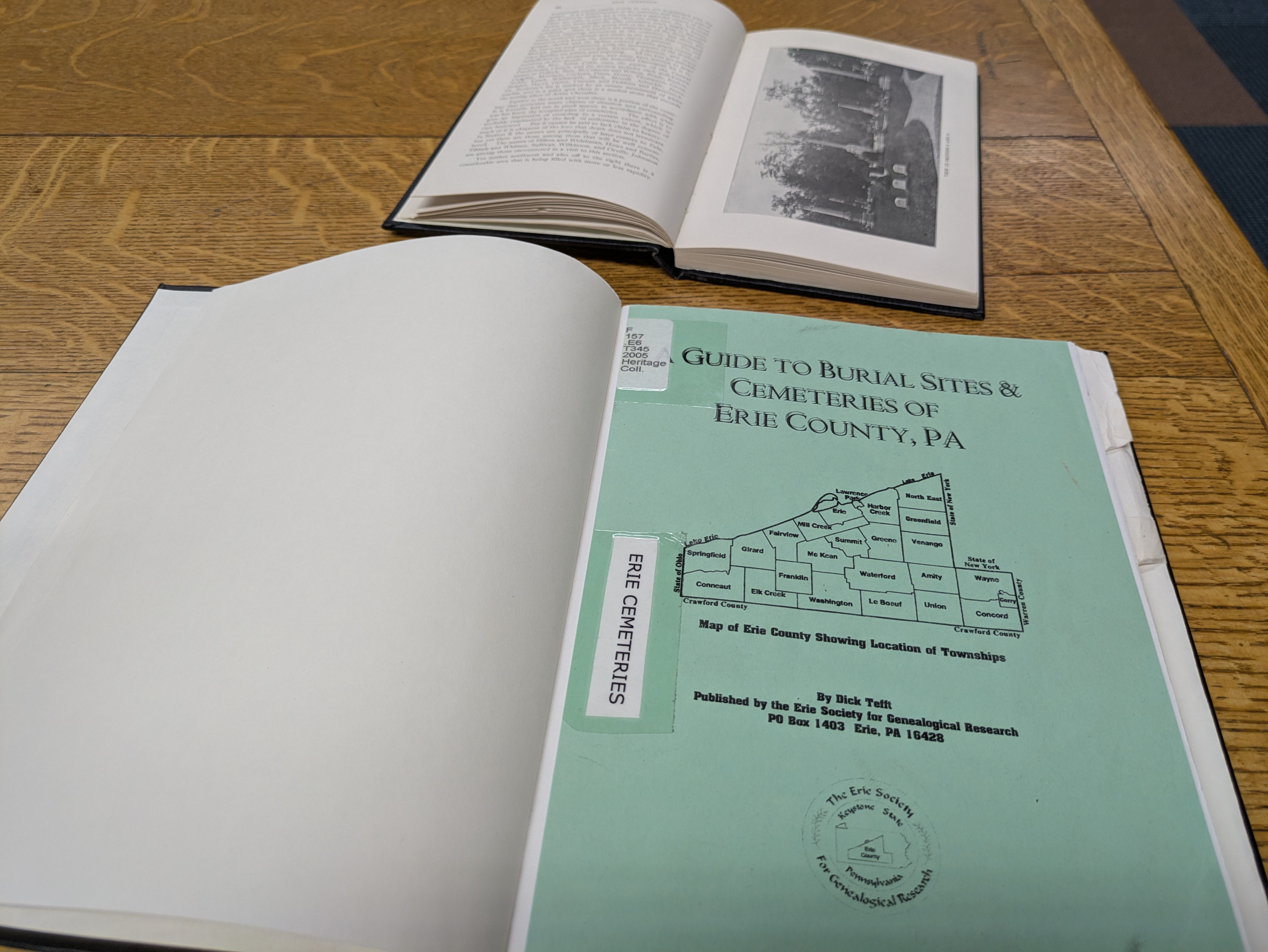
The Heritage Room at the library is a great resource for local cemetery investigations. The two books pictured here are a great place to start: Guide to Burial Sites and Cemeteries of Erie County, PA by Dick Tefft and Erie Cemetery: A Handbook. (Photo: Erin Phillips)
Steg mentions that part of what he loves about cemeteries is how, in looking at the history of them, one can see the shift in the culture around death. Early cemeteries were foreboding, mouldering, and intentionally scary – with sculptures of skulls and crossbones, reapers, and the like. They were meant to stand as stark, grim reminders of mortality and the consequence of sin. Then, post-Great Awakening, "The view moves to a rural cemetery, like the Erie Cemetery, and it's a more hopeful view of death – that opened up the whole idea of these places being more park-like."
Currently, our city's most beloved, historic, park-like Erie Cemetery established in 1851 – to which a number of bodies scattered throughout the city were re-interred to their final, pastoral resting place – is recovering from record damage incurred during the massive storm on Sept. 2, 2026. The cemetery is currently closed and will remain closed through November as crews work to clean up the damage – which has been described as the most severe the organization has experienced in its 175-year history. The cleanup is two-fold as crews work to clear the multitude of downed trees, many of which were as old as the cemetery itself, and then move to the repair and replacement of damaged gravestones. This unprecedented disaster is ultimately translating into an unprecedented cost to the organization and they're accepting donations to aid in the recovery, as many of the historic cemetery's stones no longer have living relatives caring for them. The best way to donate is to send a check through the mail to Erie Cemetery Association, 2116 Chestnut St., Erie, PA 16502.
Before I left Steg in that parking lot on Sassafras Street, I asked him: how do we keep a cemetery from being forgotten? He answers, "I think there's more awareness these days. Back in the day, they had no foresight, so they'd plow over cemeteries for farmland, especially the native mounds. But I know a lot of rural organizations have stepped up to maintain some of them. Or they've been handed off to local organizations, especially if there are veterans involved."
Off the top of our heads, Steg and I immediately came up with two sites that include cemeteries that are currently for sale – the St. James Evangelical Lutheran Church on Old Ridge Road between Fairview and Manchester and the Weis Library United Methodist Church, near Millfair and Heidler roads, and its attached cemetery. Even with a state law guaranteeing visitors reasonable access to cemeteries on private property – in 100 years, who will remember? If the stones decay or are removed, how will anyone know? Steg feels that public documentation will help, "I think there should be plaques or markers to commemorate, or make some kind of memorial out of the stones. Why can't we be more thoughtful? If there's no visual reminder of a place, it's forgotten."
Erin Phillips has a wacky idea to drive around to all of the forgotten cemeteries listed in Tefft's booklet. Anyone want to go on a spooky Sunday drive? She can be reached at erin@eriereader.com