Gem City Style: 15th Anniversary of the Erie Reader
A conversation with Brian Graham and Adam Welsh, publishers and editors-in-chief of the Erie Reader
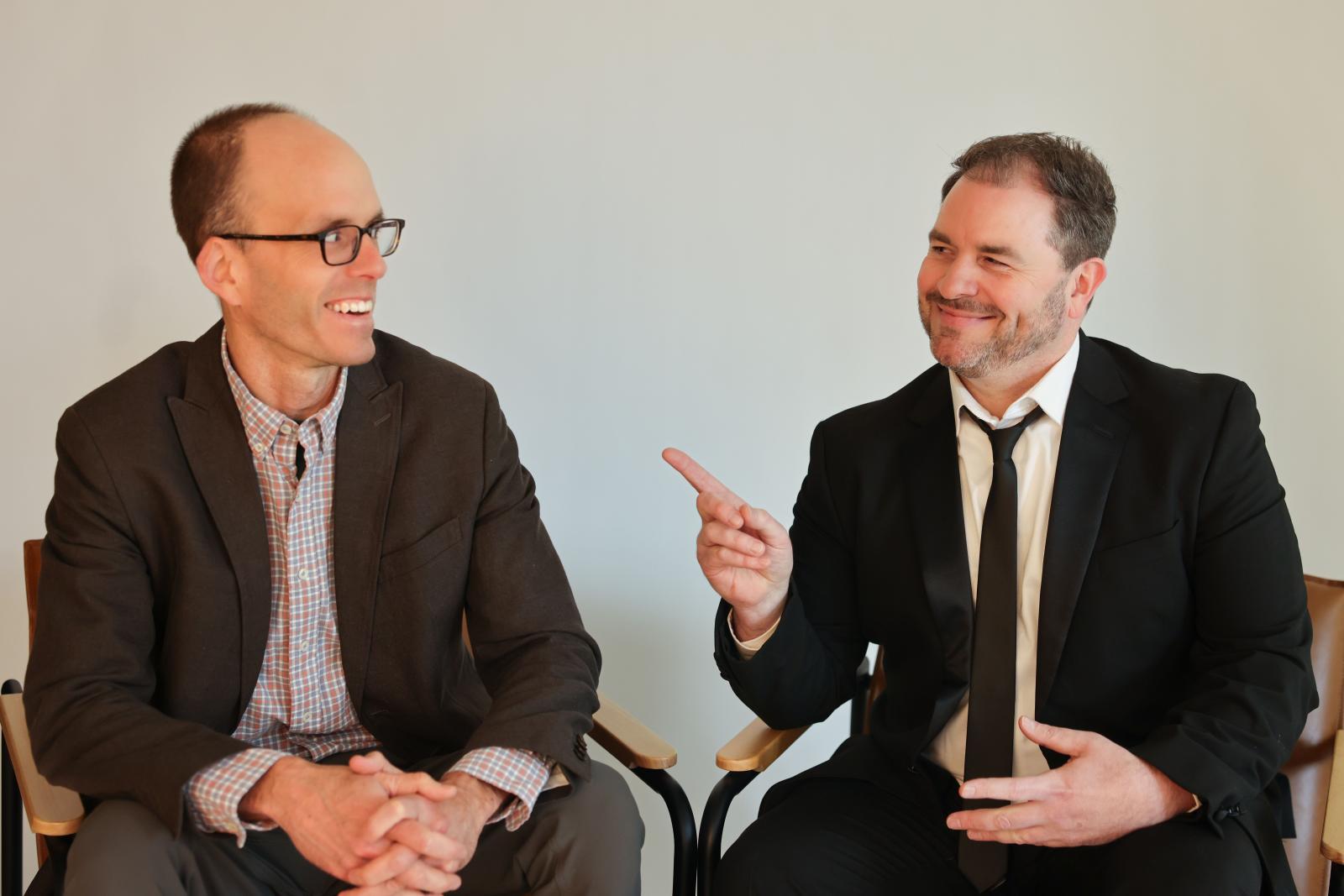
There are people in Erie who have shaped this city quietly, without much fanfare, simply by showing up and doing the work year after year. Adam Welsh and Brian Graham are two of those people – and after nearly eight years with the Erie Reader, I can say with full sincerity that sitting down with the two of them for this particular issue was one of the highlights of my time here.
I have been with the Reader since September of 2018, which means I came in somewhere around the halfway mark of this story. By then, Adam and Brian had already built something real – a publication with a voice, a reputation, and a loyal readership. But to understand how it all started, you have to go back much further than that. You have to go back to a Catholic school in Erie, a fourth-grade classroom, and a kid who walked in and immediately made everyone laugh.
Brian arrived at Holy Rosary in fourth grade, moving into a neighborhood that Adam already called home – a tight, concentrated few blocks where the same group of kids shared paper routes and grew up in each other's orbit. "We weren't in the same classes," Adam recalled, "but it was only like 50 kids in a grade. He was immediately one of the funniest kids I knew. I remember getting into a lot of trouble just laughing at his stuff." Brian laughed at the memory. From his side, the earliest memories of their friendship involve making cartoons together, cracking each other up, and causing (low-grade) trouble. That dynamic carried all the way through high school, even after they landed at different schools – Brian at Academy, then to Central, and Adam at Mercyhurst Prep – two totally different roads through Erie, but the friendship never faltered.
After living together and attending Penn State University for college, Adam and Brian ended up in San Diego, and it was there that the seed of the Erie Reader was planted. The San Diego Reader was their guide and inspiration – a free alt-weekly with a glossy cover, out every single week, covering everything from bands and nightlife to the kind of niche, deeply local stories that no mainstream outlet bothered with. "I'd never lived in a place that had something like that," Adam said. "It's how I learned about the stuff I really wanted to know about – bands, nightlife, arts, culture – but also all those other stories you get from an alt-weekly. Complementing the mainstream media, talking about the niche stuff going on in San Diego." When they'd come back to Erie for holidays, the conversation kept circling back to the same question: why doesn't Erie have something like this?
Brian was deep in a cubicle at San Diego Gas and Electric when the idea started becoming real. "I hated it," he said of corporate life. "Feeling trapped, just daydreaming." He and Adam were chatting constantly on the first iteration of Google Chat, before social media was a thing, turning the concept over and over. Adam had floated the idea as early as 2005, but it didn't get off the ground. By 2008 and 2009, Brian was done waiting. "I don't know if I ever actually thought it was going to happen," he admitted, "but we started forming the idea and I eventually made the decision to come back to Erie and try to start something."
The friendship that had survived Catholic school, separate high schools, and a cross-country relocation was now being asked to survive a business partnership. I asked them both if building something together had ever tested what they had. Adam didn't flinch. "I never saw it as a disadvantage. I don't remember any real trying times. I always thought I was so lucky to have someone I'd known for so long, someone I loved and trusted implicitly. Not everybody gets that as a business partner." Brian echoed it with the same genuine ease: "Amazingly, it hasn't. We're able to separate business and friendship pretty well. We can be arguing about a business matter and just know that it's business." Thirty-some years of history, it turns out, is a pretty solid foundation.
They launched the Erie Reader as a blog in 2010, with a countdown clock ticking toward their first print issue. It hit stands in March of 2011, right in the middle of a cultural moment when everyone seemed to be declaring print media dead. They heard that a lot. "We didn't think that," Adam said. "We thought it could actually be the perfect time." The Times-News had gone up for sale. There was an opening, a gap in the market, and they felt it. Erie had universities, a genuine arts and culture scene, and a community hungry for something that spoke directly to it. The Showcase (a well known Erie Times News weekly insert that has been retired for some years now) was the closest analogy most people had – and even that reference required some creative explaining. "People here didn't even understand the concept of an alt-weekly," Adam said, "let alone a free one. We'd say: you know The Showcase? Like that – but so much more, and free, and delivered everywhere." It was a real behind-the-scenes challenge, pitching something that didn't have a clear local precedent.
The early years were a hustle that nobody fully saw from the outside. Brian taught himself the Adobe Suite (InDesign in particular) on the fly, laying out the entire publication with zero formal design or journalism background. "I had a business degree," he said, laughing. "I was self-taught in design, self-taught in Photoshop, trying to do everything myself." Adam pointed out that the timing, for all its difficulty, was also quietly lucky. The Google Business Suite was just rolling out. Laptops were newly affordable. "We were able to do things sitting in his old apartment that genuinely weren't available before," he said. "It was a unique time to be building something like this." On top of learning to actually publish the thing, they were selling ads, keeping the lights on, and explaining their own existence to potential advertisers – all at once.
Support came from people who believed in what they were building before it was easy to believe in it. Jaimen Gallo got the initial website live and Epic Web Studios took it to an entirely new level. Dave Hunter (this writer's husband) provided assistance in shaping the digital presence and was, as Brian put it, "huge for us early on" in those critical first steps. Finding the right team members, including Managing Editor Ben Speggen, was another turning point that they both credit as instrumental. There was also a broader community of alt-weekly publishers across the country – a real cohort of like-minded people – who were generous with their knowledge. "Anybody we reached out to seemed more than willing to share what they knew," Adam said.
The moment the Reader's role in Erie really crystallized – both Adam and Brian pointed out – was with the Erie Coke story, without hesitation. The Erie Reader published a series of stories about the pollution billowing from the facility on the city's east side. One could see the smoke from the Reader office's windows on the 13th floor of the Renaissance Building. A Facebook group formed in response to those stories and a community movement followed. The plant was eventually shut down. "You could really see our impact," Adam said. I was there for some of that, watching them grab their cameras every time that smoke started billowing. It didn't feel small at the time, and it wasn't.
The Perry 200 Commemoration project was another turning point – it put Brian and Adam in rooms and conversations with Erie's decision-makers in a way they hadn't experienced before, and it pushed the publication into a deeper, more sustained focus on Erie's identity and branding. "We really harped on the branding of Erie a lot," Adam said. "That was an early beat, and it's still a super relevant conversation in this town – we've been on it for all 15 years."
.JPG)
Photo: Jessica Hunter
That focus on identity runs through everything the Reader does. The 40 Under 40 list, Best of Erie – these aren't just popular features, they're intentional acts of civic cheerleading, executed with care. "It's not pay to play," Adam said firmly. "We are just trying to identify people who are going to keep moving Erie forward. We come at these things from a genuinely earnest place." Brian added that the pushback never fully goes away – every cycle of 40 Under 40, every Best of Erie – but that it doesn't change their approach. What it does, quietly and consistently, is give Erie's champions a place to be seen. "Before us," Adam reflected, "if you were only reading Facebook comments, you'd have a pretty dim view of this city. We try to give it a positive spin." Brian was characteristically more direct about it: "Erie is pretty risk-averse. That's been the story of this city for a long time. There are a lot of us who want to keep pushing it forward. That has always been part of the ethos of the Reader."
Championing the arts has been one of the publication's most consistent and quietly important roles. "There are so many talented people here," Brian said, "and this has been one of the primary outlets to let people know about them." Their environmental coverage represents another body of work he's proud of – Erie Coke, bomb trains, invasive Asian carp – the kind of reporting that doesn't always get its flowers in the moment but matters enormously to the community it serves. And then there are the cultural artifacts, like the early blog post about saving the 814 area code, which Brian brought up with a kind of nostalgic glee. Before the print edition even launched, that post generated more reader response than almost anything they'd published. "People lost their minds," he said, grinning. "They were going to split us off from 814, and it was like – absolutely not."
When I asked how their understanding of what Erie needs from a publication like this has shifted over 15 years, Adam didn't hesitate. "The importance of the Erie Reader has only grown." He spoke warmly about journalists like Ed Palattella and Lisa Adams – people still doing real local reporting – but was clear-eyed about what's been lost as outlets like the Erie Times-News have changed hands and scaled back. "There's a huge disconnect when those news organizations are not owned locally anymore," he said. "We've always been hyper-local. We've always asked: what's the local angle? And I think that's only become more important as the years have gone on." The question of what keeps the Reader alive and profitable, when so many alt-weeklies across the country have folded, comes back to something simple. "A thirst for that local touch," Adam said. "People in this town really appreciate work that is from Erie and about Erie. We can deliver something that is genuinely needed in this community. That's always been our aim."
I asked them both what the next 15 years look like. Adam said they're making decisions with long-term sustainability in mind – thinking about this as a platform, building it into something that functions even more fully as a community asset. The specifics, he noted, are still taking shape. Brian, ever the other half of a well-timed duo, offered his answer in two words: "Stay tuned."
Fifteen years in, these two guys from Holy Rosary are still at it. Still laughing. Still finishing each other's sentences. Still pushing Erie forward one issue at a time.
Gem City Style is a monthly column featuring an intimate profile of someone making a creative impact in Erie. If you or someone you know would make a good fit for a future Gem City Style, email jessica@eriereader.com