Gem City Style: Shateria A. Franklin
Speaking with the founder of Destiny of Our Daughters before Erie Gives Day 2026

Every year, at the end of the Destiny of Our Daughters conference, about a hundred Erie girls get dressed in whatever makes them feel most like themselves, walk a red carpet, and hear their own names read out to a room full of people clapping for them.
Shateria Franklin (40 Under 40 Class of 2023) has spent 11 years building toward that, and she'll tell you it was never really about the clothes. It's about a girl finding out what it feels like to be looked at on purpose – and deciding she can hold up under it.
Since 2014, Destiny of Our Daughters has worked with Erie girls ages 8 to 18 – Black and brown girls in particular – through mentorship, conflict resolution, college prep, and a youth council that runs much of the organization itself. All of it points toward a two-day empowerment conference each year, which ends with the gala.
She arrived at my studio in a black-and-white polka dot top and pink glasses, and I loved it immediately – polka dots are kind of my thing. I'd already kicked my shoes off, and told her to do the same, because that's the kind of afternoon it was going to be. What I got over the next hour wasn't a mission statement. It was a life, laid out in order, with the organization sitting in the middle of it.
"I love this organization with every fiber of my being," she told me early on, then spent the next hour proving it.
Franklin is 34, and her resume is Erie all the way down: East High, Class of 2010. Gannon undergrad in 2014, master's in 2018, and a seat now on the university's academic advisory board. A published author. An Erie Reader 40 Under 40 honoree in 2023. Today she's a community school director for United Way of Erie County – so the girls she serves through her nonprofit are, often enough, the same ones she's alongside during the school day.
But when she describes herself, none of that comes first.
"I'm just a person who has gone through extreme adversity," she said. Her father died when she was 14, and this year brought another significant loss. "I talk about loss a lot, because I realize how much of that has been an important piece of who I was able to become."
The losses, though, are only half of it. The other half is women.
"I always had people and women who believed in me," she said – a wonderful mom, wonderful grandparents, and a middle school assistant principal who watched a straight-A student slide to Cs after her father's funeral and pushed her over the finish line anyway. "She believed in me," Franklin said. "And I never forgot that."
"Destiny of Our Daughters is a bright spot in all of the loss that I've taken," she said, "because it is truly a direct reflection of what it means for people, and for women, to believe in you."
The idea found her unexpectedly, in college, when girls she barely knew started telling her they admired how she dressed, how she carried herself, how she talked. "Then I thought, wait a minute – this is the same thing someone said they saw in me when I was a little girl," she said. "Now other people are starting to see it, and I want other girls to know that I see them."
What she wanted was specific. "I really want Black and brown girls in particular to be seen, to be heard, to be felt," she said. "To know that they can do whatever, no matter where they come from, that you can literally be whoever it is that you know you were created to be."
The first gathering came in 2014, in a borrowed room at Strong Vincent High School, set up like a workshop for lack of a better term. "It was very small but powerful," she said. "I was scared, because I just didn't know what it would be."
The girls who showed up were age 10 to 13 – timid, unwilling to ask a question. By the end of the afternoon they were talking to each other, making friends, being themselves.
"And I was like, this is it."
.JPG) Photo: Jessica Hunter
Photo: Jessica Hunter
After extensive research, the 501(c)(3) came through in 2018, and a formal board followed in 2020. Ask what she wishes she'd known and there's no pause at all. "That it's okay to ask for help," she said. But she wouldn't trade the route. "I appreciate every single moment of growth we've had. I don't think I'd change anything about how I got here." She is also nowhere near finished. "We haven't reached where I believe that we will go yet," she said.
The Youth Ambassador Council is a group of high schoolers who serve as a working board of directors. They pick the conference theme. They pick the speaker. They lead. It exists because the girls asked for it. "It's a thing to say something," Franklin said. "We tell kids all the time to speak up for themselves. But if we don't put any action behind speaking up for themselves, then their voice is a little bit diminished. So I let them lead. Tell me what you need."
College Knowledge, a 12-week intensive workshop, exists because Black girls in Erie are not only underrepresented in college numbers but underprepared for the application itself. The program walks them through essays, applications, and scholarships, and every woman facilitating – professors, people in higher ed – looks like the girls across the table.
The six-week conflict resolution curriculum came out of her days inside Erie's schools, and out of years watching friends cycle in and out of trouble over conversations that could have gone another way. The work is showing them a disagreement isn't a fight waiting: "I can disagree with you, you can disagree with me – you might actually be right, I may actually be wrong. And both of us may be right, and we can coexist. Two things can be true at the exact same time."
By week six, she said, you can watch a girl decide not to roll her eyes. Teachers notice before the girls do.
Of the four words at the center of the mission – hope, wisdom, courage, power – I asked which is hardest to teach. "Hope," she said. "If you come from a community where all you see is chaos and brokenness, you tend to think that you are a product of all the things around you. If no one around you graduated from high school, you tend to believe that it's not made for you."
So she is deliberate about who the girls see – who speaks at her events, who volunteers, who leads. Hope isn't something you can talk a girl into. She has to watch it walk into the room. "When you start to see women who look like you – wait a minute, she's an executive. She owns a business. She's an author. And she grew up right where I grew up, in the projects," she said. "And she didn't leave Erie and come back. She did it right here."
And then she says something I've been thinking about since: "I want them to see a version of themselves that they often know is there, but they don't know how to get there. It's in their heart. They have the desire. I see girls every day. I see versions of myself in the girls every day."
Some of those girls are seniors now, filling out the applications her program walks them through. "They came in five years ago," she said, "and they wouldn't even hold the mic to their voice and say their name."
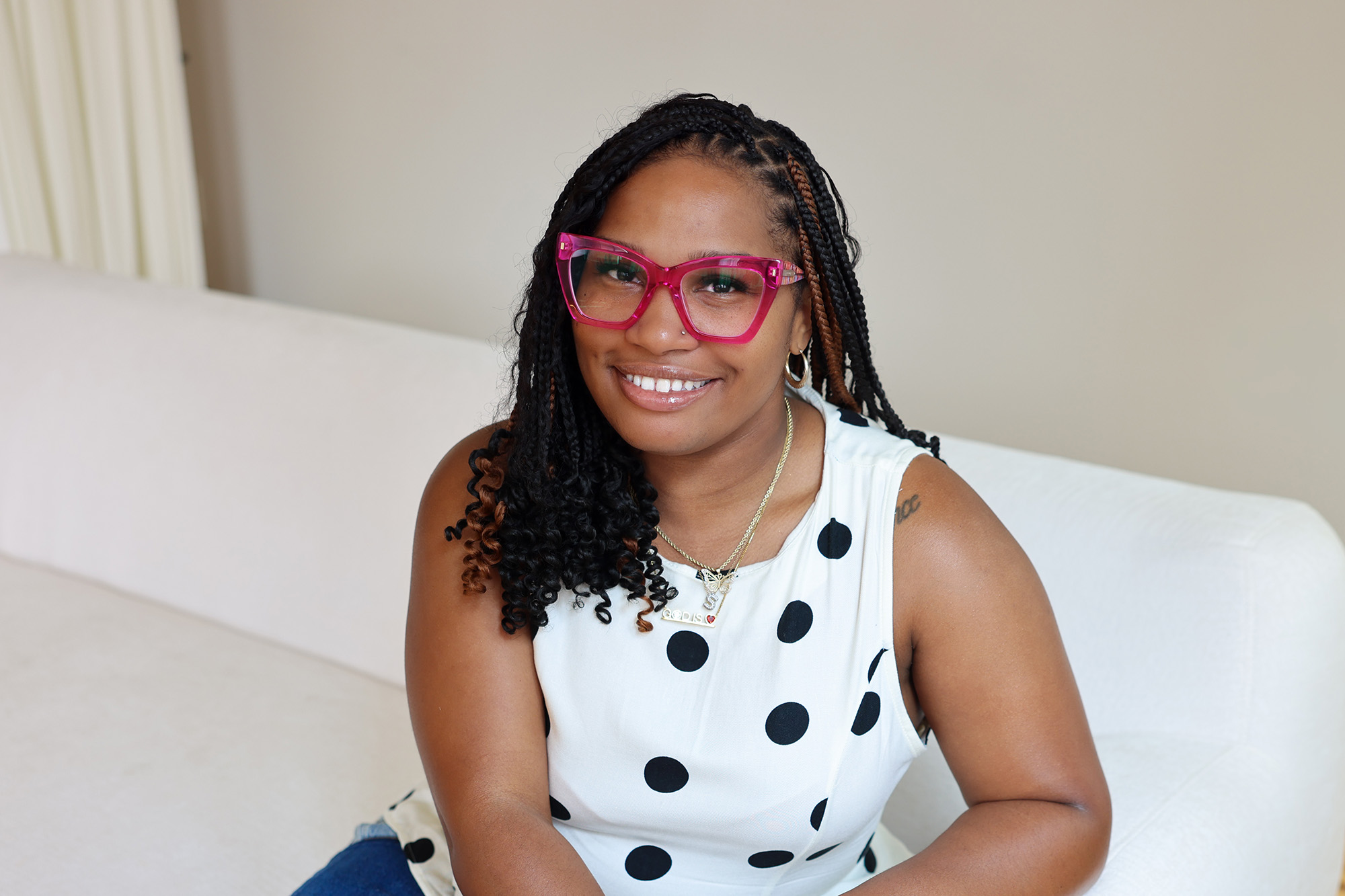 Photo: Jessica Hunter
Which brings us, eventually, to the clothes – because in Franklin's case the two things were never separate. She was the girl at Wilson Middle School who wore heels to class, and her high school friends still resurface it online, tagging her under old photos: this was you, Shateria. Behind it is a great-grandmother and a sentence.
"If you look good, you feel good," Franklin said. "She was always on us about the way we presented ourselves. I don't think that we correlate the way that we feel with the way that we look." So the conference's second day is a gala: a red carpet, a photographer, a photo booth, and awards handed out by name to young women who are doing well.
Franklin didn't learn to dress for such events until she was an adult, often as the only woman who looked like her. "So I get them in a room where everybody looks like them," she said. "Different shades, different hair – and their personality gets to shine through the formal wear."
Franklin runs all of this alongside a full-time job and three children, and describes it as alignment rather than strain. Her daughter is always around. Her sons come help her set up. They're watching what it looks like to lead, to juggle, and to rest when you need to.
"It's all my purpose," she said. "That's how I know it's meant for me."
The organization has also done something she didn't plan for – reached past the girls entirely. The women who volunteer, facilitate, and lead tend to leave with something of their own. "I've literally seen my organization assure other women that they are who they believe that they are," she said.
Near the end of the afternoon I asked what she wants the organization to look like in 10 years, when the girls from that first cohort are old enough to run it. She pulled out something she'd written down – every year she picks five keywords for the year ahead, and one of last year's was legacy. Partway through reading it aloud, she stopped to acknowledge she was tearing up. By then, so was I.
"It's not about my name being remembered. It's about the work continuing well after I'm around," she said. "It's seeing young girls that I once poured into become women who pour into someone else. And it's women who understand the responsibility and the power that you have in reaching back to pull up the next generation."
She has thought further ahead than most founders permit themselves.
"I don't plan to live and die here," she said. "I want to build a foundation where someone can come and take it well beyond what I could have ever even imagined. And that's leadership. I don't think that we always have to hold on."
What she pictures is a girl who came through the program at eight growing up, gaining confidence and experience in the real world, and applying for the executive director job.
"And when they think about their story, they'll say: I was connected to an organization called Destiny of Our Daughters when I was 10, 11, 12 years old, and because of that I learned how to speak," she said. "I learned that I could go to college as a first-generation student. I learned that leaders do look like me."
One last question, because I couldn't help myself: if Destiny of Our Daughters were an outfit, head to toe, what is it, and who's wearing it?
She didn't need long. Michelle Obama is wearing it. It's bold and loud and almost certainly pink, because there is a great deal of pink in this organization. Patterns, obviously. Pink glasses. A two-piece pantsuit, a statement flower – the whole thing built to stop a room.
It took me a beat to catch what she'd done. Sitting across from me in polka dots and pink frames, she had described the organization and described herself, and hadn't noticed the difference.
But it isn't about taking the room.
"Not stealing the room," she said. "Shifting the energy. And allowing other people to be like, oh my gosh, where'd you get that." Starting a conversation, she said. Being inviting. Sharing.
Which is, more or less, the whole method: walk into a room, make it bigger, hold the door. Eleven years of it, and she's not planning to do the next ten alone – she's actively looking for women with expertise in fundraising and leadership to join the board, and she'd like Erie to know it.
To learn more about Destiny of Our Daughters, to volunteer or mentor, or to inquire about board service, visit destined2be814.org or find them on Facebook and Instagram.
Destiny of Our Daughters is participating in Erie Gives Day on Tuesday, Aug. 11. Visit eriegives.org to donate.
Gem City Style is a monthly column featuring an intimate profile of someone making a creative impact in Erie. If you or someone you know would make a good fit for a future Gem City Style, email jessica@eriereader.com