The Improbable and Tragically Short Presidency of James Garfield
Nation's 20th president pushed back against Gilded Age corruption

Just a short drive away from Erie, in Mentor, Ohio is the James A. Garfield National Historic Site, an estate known in its times as Lawnfield. If you don't know much or even anything about James Abram Garfield or his family, you're not alone. While a 2014 study by the journal Science found that Chester A. Arthur (Garfield's successor), Franklin Pierce, and Millard Fillmore are the "worst-remembered" presidents, it is fair to say that many people don't know much more about Garfield beyond his sharing of a name with a lasagna-loving orange tabby and, perhaps, his eventual fate.
James Garfield was always an unlikely presidential candidate. To this day, he remains the only sitting U.S. Representative to win the presidential election and ascend directly to the White House. As Garfield wrote in his diary in 1879, a mere year before accepting his party's improbable nomination: "Few men in our history have ever obtained the Presidency by planning to obtain it." By the following summer, Garfield was running for President of the United States and operating a fascinating campaign from the front porch of his Ohio home.
Garfield, if an unlikely presidential candidate, was still a well-known politician. In his long congressional career, he'd made a name for himself in his association with the Half Breeds, one of the Republican Party's competing factions. This faction, led by Speaker of the House and then-Senator James G. Blaine, pushed back against the party bosses and machines that ruled the political system. This was an era of significant Gilded Age corruption, cronyism, and fraud, realities not lost on Garfield, who deeply understood the machine politics of his time. The opposing faction was the Stalwarts, led by New York's powerful Roscoe Conkling, the crooked "king of the spoils system."
Rewind to a few years earlier on July 4, 1876. Congressman Garfield, or General Garfield as the press often described him due to his Civil War heroics, gave a speech to commemorate the Declaration of Independence's centennial anniversary. In it, he directly addressed this growing government malfeasance.
"Now more than ever before, the people are responsible for the character of their Congress," he proclaimed. "If that body be ignorant, reckless, and corrupt, it is because the people tolerate ignorance, recklessness, and corruption. If it be intelligent, brave, and pure, it is because the people demand these high qualities to represent them in the national legislature."
His constituents, perhaps sensing these were not merely empty words, rewarded him with another term that fall – and, only a few years later, the nation would do the same by sending him to the White House.
Garfield was, as explained by the White House Historical Association, "the last of the log cabin presidents," born on a farm in Ohio's Cuyahoga County on Nov. 19, 1831. His family struggled financially, worsened by his father Abram's death in 1833 following a fire. This left his mother Eliza to raise the five Garfield children on her own. Young James loved his mother deeply, but longed for the father he never really knew. He was often solitary and spent much of his time reading, citing Charles Dickens and specifically David Copperfield as among his favorites. He also loved being outdoors and dreamed of someday being a sailor.
At 17, having survived the "chaos of childhood," as he described it (which included a year of working on canal boats between Cleveland and Pittsburgh), Garfield was unsure what to do with his future. He soon enrolled at the Geauga Seminary. He was an excellent student. He had a knack for languages and was captivated by the power of public speaking. "I love agitation and investigation and glory in defending unpopular truth against popular error," he wrote.
It was there he met Lucretia Rudolph. In 1858, they married at the Rudolph estate in Hiram, where the two were employed as teachers at the Western Reserve Eclectic Institute (later renamed Hiram College). In 1861, he was admitted to the Ohio bar. This was around the time he began dabbling in state politics. Then, the Civil War erupted.
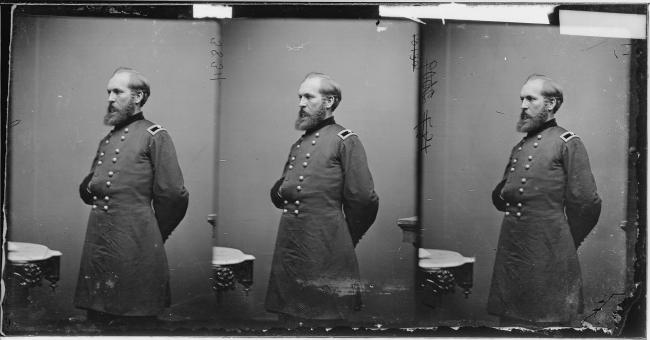
In 1862, Garfield led forces in the Battle of Middle Creek during the Civil War, after which he was promoted from colonel to brigadier general at age 31. (Photographed by Mathew Benjamin Brady - National Archives)
Garfield, already an outspoken abolitionist, spent the early months of the war focusing on recruitment before earning a commission as a colonel in the 42nd Ohio Infantry regiment. In 1862, he led forces in the Battle of Middle Creek, which led to his promotion to brigadier general at age 31. Following his survival at the Battle of Shiloh later that year, he returned to Ohio to recuperate from an illness. He was convinced during this time to run for a seat in the House of Representatives. He won and received President Abraham Lincoln's blessing to resign from his military commission to serve in Congress. Garfield was soon associated with the Radical Republicans faction of the party alongside Senator Charles Sumner and Representative Thaddeus Stevens.
Following the war and Lincoln's assassination, Garfield addressed the president's death on the House floor. "It was no one man who killed Abraham Lincoln," he said. "It was the embodied spirit of treason and slavery, inspired with fearful and despairing hate, that struck him down in the moment of the Nation's supremest joy."
As part of the Reconstruction era Congress, Garfield desired to make a lasting difference. "I am trying to do two things," he wrote in an 1867 letter. "[D]are to be a radical and not be a fool, which, if I may judge by the exhibitions around me, is a matter of no small difficulty." During "piping times of peace," normal political maneuvering was needed, but, he argued, only the radicals "ever accomplished anything in a great crisis." This included full citizenship for those freed from slavery, including the right to vote for the men.
"The chief duty of government is to keep the peace and stand out of the sunshine of the people," he alleged. Over the next decade, he would prove himself a skilled, intellectual, and respected congressman. In June 1880, he gave a speech in support of Ohio politician John Sherman's presidential nomination at the Republican National Convention in Chicago. This speech was so well-received that it inspired a campaign to nominate a reluctant Garfield as a "dark horse" candidate instead.
It's a long and fascinating tale itself, but the CliffsNotes: after plenty of deadlock and drama (and 36 ballots), Garfield, to the shock of many, emerged as the compromise candidate. Chester A. Arthur, a close ally of Stalwart rival Roscoe Conkling, was selected as his running mate.
Following his nomination, Garfield traveled back home to Mentor. Over the following months, his Lawnfield homestead transformed into a hub of excitement and activity with thousands of visitors leading up to the November election – as many as 15 to 17 thousand, according to the National Park Service.
While actively campaigning for oneself was generally frowned upon during this political era, candidates still maneuvered behind the scenes. Garfield traveled to New York City to assure Stalwarts that they wouldn't be iced out of his administration if he gained their support. While there, he addressed thousands in Madison Square Park in what became known as his "Boys in Blue" speech.
"Gentlemen, ideas outlive men, ideas outlive all earthly things," he spoke directly to the veterans in attendance. "You who fought in the war for the Union fought for immortal ideas, and by their might you crowned the war with victory." There was thunderous applause. "We meet tonight as comrades to stand guard around the sacred truths for which we fought." This included suffrage for their "black allies" who they must "stand forever" with as they would never "betray the flag and fight to kill the Union."
"In the extremity of our distress, we called upon the black man to help us save the Republic," he'd previously declared. "[A]nd amid the very thunders of battle, we made a covenant with him, sealed both with his blood and with ours. … [T]o grant suffrage to the black man in this country is not innovation, but restoration." These views and his impressive oratory earned Garfield the support of famed abolitionist Frederick Douglass.
"James A. Garfield must be our president," said Douglass in a meeting at the Cooper Institute in New York. "He has shown us how man in the humblest circumstances can grapple with man, rise, and win. He has come from obscurity to fame and we'll make him more famous."
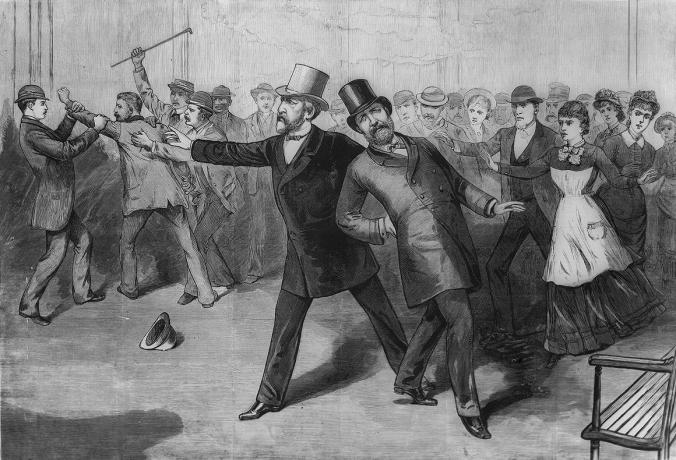
This drawing, published in Frank Leslie's Illustrated Newspaper, shows the assassination of James Garfield, a down-to-earth, progressive politician for his time, who lived in nearby Mentor, Ohio and who was only able to serve as president for 200 days before his death. (A. Berghaus and C. Upham, published in Frank Leslie's Illustrated Newspaper)
Back in Mentor that October, a group of 400 young men traveled by rail from Cleveland to Lawnfield to meet Garfield. "I know of nothing quite like this in our history," remarked Garfield to the excitable crowd, their visit which he described as "a compliment of the highest sort." Before seeing them all, he quipped, he had still considered himself a young man. The crowd erupted in laughter and applause. "[T]hey tell me that you are to cast our first national vote," he noted. "If that is so, young man as I am, I was a voter before any of you were born."
Garfield veered away from politics and emphasized the importance of one's home. He stood only 15 miles from where he spent his childhood, he said, and to him, there was nothing "half equal in glory" to being "here at home" with his family.
"[There] is a delusion that affects … particularly the young men – the delusion that good things and great things are some way off, yonder, away, abroad," he observed. He said that among his own generation, they wrongly believed that glory and greatness were something achieved far away from home. Experiencing the world to "enlarge our minds" had value, but, Garfield stressed, accomplishing great things can be done where one comes from as well. He then added that "nothing to me in this world is so inspiring as the possibilities that lie locked up in the head and breast" of the youth before him. "Such guardians, such defenders will keep the Republic pure and keep it free," he concluded.
The election against opponent Winfield Scott Hancock was on Nov. 2, 1880. While the popular vote separating the two was a razor-thin 2,000 votes and both won 19 states, Garfield carried the electoral college: 214 to Hancock's 155.
"The Town is all excitement. It is indeed an occasion of rejoicing such as Mentor never experienced before," a report read the following day. Garfield's neighbors were "like schoolboys out for a holiday." Cheers were "hearty and frequent." Lawnfield was swarmed by supporters. "Amid all this scene of excitement," the report continued, "the coolness and self-possession of the President-elect was something remarkable." Lucretia stood by his side with "a look of happiness and deep affection."
Garfield was inaugurated as the 20th President of the United States on March 4, 1881. As many hoped, he challenged Conkling and his Stalwarts from the beginning. He tackled civil service reforms. He began pushing for civil rights legislation. Sadly, President Garfield would never get the chance to see many of his ideas through.
On July 2, 1881, while walking through a D.C. railroad station with his two sons, Secretary of State James G. Blaine, and Secretary of War Robert Todd Lincoln, an unstable Charles Guiteau, obsessed with Garfield and his presidency, stalked and then shot him. Guiteau was quickly detained while Garfield was taken to a room inside the station to be examined.
"Tell [Lucretia] I am seriously hurt," he insisted. "How seriously I cannot yet say."
As the weeks passed and his body fought infection, it became more and more serious. While battling weakness and waves of delirium, he would speak of Mentor and Lawnfield, of "meeting and greeting old friends" along the familiar Ohio roads. "He talks of little else," it was reported on Aug. 26, 1881. He desired little more than to go home, but as the report grimly stated: "He will die if he is moved. He will die if he remains." After a few more weeks of agony, James A. Garfield died on Sept. 19, 1881.
A few years later, at the unveiling of a statue honoring Garfield, future President William McKinley, another Ohioan who himself would be assassinated shortly into his second term, eulogized his friend Garfield as a "leader and master."
"[N]ot by combination of scheming, not by chicanery or caucus, but by the force of his cultivated mind, his keen and farseeing judgment, his unanswerable logic, his strength and power of speech, his thorough comprehension of the subjects of legislation," said McKinley.
Today, Garfield's legacy continues to be honored at Lawnfield, just a little over an hour's drive from Erie. There is no fee to visit the site and parking is free. From June through October, the ground and Visitor Center are open from 10 a.m. to 5 p.m. with daily guided house tours offered throughout the day. They also offer two cell phone tours (accessible at jaga.oncell.com): one as a general overview of the Garfield estate, the second covering the 1880 presidential campaign. The National Park Service describes the homestead, where Garfield "greet[ed] thousands of well-wishers during his presidential campaign" as "a gateway to the story of the Garfield family."
In 2013, The Washington Post editorial board published that Garfield, who was as human as anyone, "may have been the best president we never had, or hardly had." It's possible that President Garfield is finally having a moment. In 2025, Netflix dramatized his ascent to the presidency in the extremely well-received limited series Death by Lightning in which Michael Shannon portrayed him. This was adapted from 2011's Destiny of the Republic: A Tale of Madness, Medicine and the Murder of a President by Candice Millard. A more recent biography that delves further into his life is 2023's James Garfield: From Radical to Unifier by C.W. Goodyear.
"The lesson of history is rarely learned by the actors themselves," Garfield once wrote. Perhaps some of those lessons from Garfield's life can be learned by us today.
Jonathan Burdick runs the public history project Rust & Dirt. He can be reached at jburdick@eriereader.com