Art Review: The 2023 Nicole and Harry Martin Spring Show
One Hundred Years of Looking
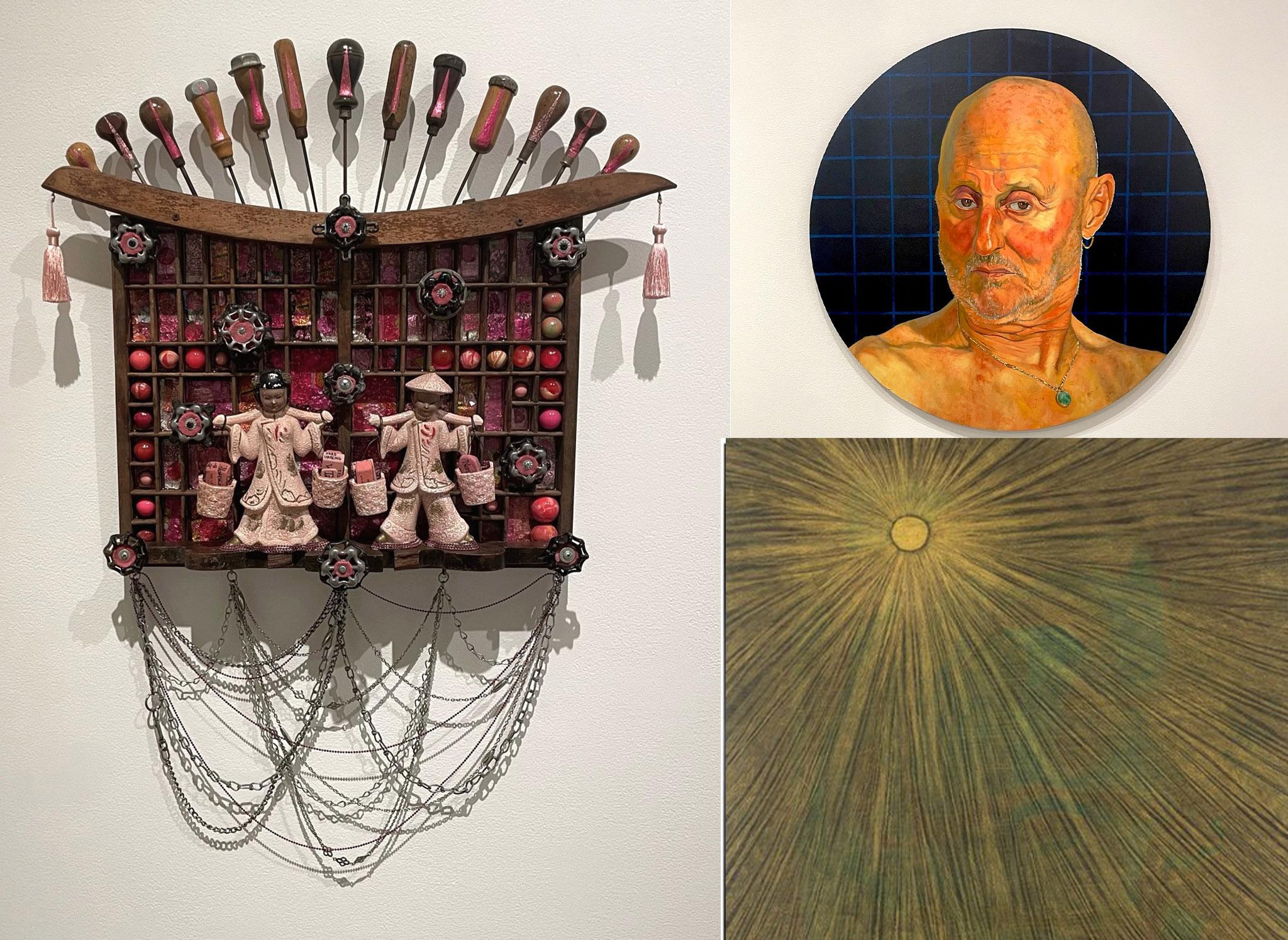
The 100th Annual Spring Show is up and running at the Erie Art Museum. I've been meaning to take a look, and during a cold, gray April, spending time in galleries seemed like the perfect thing to do. The Spring Show is a juried exhibition and a yearly litmus test for artists within a 100-mile radius. Each year the show is judged by a new juror who has been invited by the museum along with a panel of professors from the Art Department of PennWest (which will always be Edinboro to me, despite its new title).
The national climate of visual art has seen a huge influx of work based on identity, sexuality, gender, and race. This trend, of course, seems a direct response to the insistently repressive, negative vision of a national conservative agenda that is responsible for the recent sharp rise in racism, homophobia, and book-banning. Prominent artists such as Simone Leigh, the late Keith Haring, and Dawoud Bey, paired with Carrie Mae Weems, all have major exhibitions coming this year that specifically deal with the topics of racial and sexual identity.
This year's juror Gaetane Verna has made these social issues and the subject of diversity a focus in her vision of what an art institution should engage in. Her time at the Power Plant in Toronto and at her current position at the Wexner Center at Ohio State University has allowed Verna to address these themes with shows whose artists represent many backgrounds and cultures. As a curator she strives to bring the world, with all its colors and variations, to our doorstep and introduce that complex world to her audience. Knowing her perspective on art, I was intrigued by what types of work would be chosen for the exhibit.
Artwork engaged in themes of race, sexuality, diversity, and current political issues populate the Spring Show. There are portraits that deal with queer identity, photographs that explore poverty, and found object constructions that reveal the artists' feelings about their own ethnic background and how it is viewed in contemporary society. There are also works about social issues such as pollution, job loss, and urban planning.
I noticed that, with each piece, the artist included a statement explaining where the impetus of the work originated or how it was conceived, evidently to avoid any confusion on the viewer's part. I wasn't sure if these statements were necessary or helpful. I don't always want to be led when viewing art, rather I tend to read artists' statements after viewing the work to see if I'm seeing what the artist sees. In this instance, the statements did not leave room for alternate visions. This show appears specifically built to increase awareness of today's social problems and give voice to artists who are trying to make positive changes in our world. What surprised me most while looking at many of these pieces was how unmoved I often felt. For all the controversy that these subjects are supposed to invoke, I saw the work as both collectively affable but tame.
There was an amazing level of craft in the work of artists Gwen Waight and Hayden Hanes, whose assemblages were delivered with both an impeccable eye for choosing the objects used and an artisan's attention to detail in their construction. Elizabeth Prindle inserted colored rolls of thread and antique photographs into her wood constructions that were made to look old, like visual memories of times past, birth to death, in the life of a woman — the thread representing both time and motherhood. All three of these artists made entrancing work, but I was not left with much to ponder after being awed by the sheer aesthetics of the pieces.
I found the photographs of Fred Scruton an interesting comparison to the bricolages. Scruton has spent years meeting, photographing, and championing "outsider" or "naïve artists" — people without formal art training and not involved in mainstream art. In most cases, these artists — like the three mentioned above — also use found objects or recycled materials to create their work, usually out of financial necessity. Most of these artists make work based on life experiences or have received instructions from spiritual callings. Seeing Scruton's photos showing these artists' female dolls, painted collages of magic symbols, and brightly decorated scraps of wood made me think about these objects in comparison with Prindle's work. Here were people who used similar found objects but with no art school background, and they also made work with a message.
One of Scruton's photographs was of Joe Minter's "Memorial Sculpture for Hilda Minter," part of his larger "African Village in America'' installation, which is made up of discarded bricks, metal, stone, and objects found at flea markets or on the side of the road in his home state of Alabama. Here in this show, we had artists from different backgrounds addressing the same issues. As much as I like Scruton's images, I found myself wishing for the tangible objects he photographed to be in front of me in the gallery. They looked raw and more dangerous in comparison to the finely executed, well-crafted pieces that are on display.
As much as I understand political work to be important, especially over the last few years, I find myself often becoming numb in its presence. I'm not sure if its failure to move me stems from the increase in political work I've been seeing or because much of the imagery that represents these issues is used so frequently. This work will always be important, but part of me wants to see artwork where the work's edict is not so obvious. Sometimes you need to see an artist's intention right up front, but I still like to feel that an artwork gives me room for contemplation; that there are depths to explore.
One of my favorite artists is Martin Puryear, who also deals with issues of history and race. What I love about his work is that its themes don't reveal themselves outright. For example, his red cedar sculpture "Big Phrygian" in the Glenstone Museum uses a slightly abstracted form of the Phrygian cap, the preferred headgear — originating in ancient Greece and Rome — for formerly enslaved people to represent liberty and the pursuit of freedom. His "Ladder for Booker T. Washington" consists of a 36-foot-long ladder that grows smaller as it ascends, representing the struggle and slow progress for racial equality. These themes connected with emancipation from slavery, however, are rendered with visual depth and historical perspective, and only through a bit of research or a prolonged contemplation does the issue's resonance become clear.
I did find this feeling of depth in the work of Angie Jennings. Her fascinating colored pencil drawings pulled me in, and I couldn't stop looking at them. I don't know what they were about and I don't care; they are so beautiful that the "about" doesn't matter. When I read the artist statement and learned the drawings were inspired by Victor Green's "Negro Motorist Green Book" and were imagined images of supernatural sites of escape, I was pleasantly surprised. Her drawings are so seductive that knowing their origins only strengthened my appreciation.
Other work that stood out to me were Sarah Jacobs' portraits. Her subjects were set on intensely decorative backgrounds that she constructed digitally, then applied in oil. If you know Kehinde Wiley's work, these paintings have a similar feel with the patterns filling the entire negative space. These portraits are well-executed, with amazing detail, and have an underlying aura of joyfulness that makes you smile along with the subjects.
"Selections from the Industrial Valley," photographs by Samuel Huryn, are well composed documents of a dying part of our country's infrastructure. They were printed small and grouped together, and the sample made me want to see a longer series, perhaps in book form. Huryn has a good eye for composition but also brings an irony into the photographs that sets them apart from similar work I have seen.
There were other pieces I liked but was not as captivated by — which is perhaps an inevitable result of group shows. However, when a variety of artists are involved, one can see a collected group of ideas at once, which allows the viewer to connect with the work of different artists. What I may have missed, another viewer may have discovered. The downside of group shows is that one is only able to see a piece or two from each artist and not the whole vision of an artist's efforts.
This show, in its 100th year, has featured many different styles and art movements throughout its history. An exhibit of acquired pieces from previous Spring Shows is running in tandem with this one, and I encourage the visitor to see both, as a "compare and contrast" exercise. This annual show is good for our city because it introduces new art to Erie, and viewers can see what is being created visually in the region. At 100 years, the Spring Show has demonstrated not only its stamina but its importance. You only miss out if you don't take a look.
The 100th Annual Nicole and Harry Martin Spring Show runs until Aug. 11th at The Erie Art Museum, 20 E. 5th St. For hours and pricing visit: erieartmuseum.org
Justus Cotterill has an ongoing studio practice in Erie. He holds a BFA from the Cleveland Institute of Art and a MFA from Edinboro. He can be found at justuscotterill.com